Hyperbeat Pay is the card of the Hyperliquid ecosystem's yield layer: a Visa credit/debit hybrid where a self-custodial smart wallet (ManagementAccount) settles spend from your beatUSD/USDC balance or JIT-borrows beatUSD against BTC/ETH/SOL/HYPE collateral in dedicated Morpho markets - spend without selling, audited by Zellic/Nethermind, issued by Third National under Visa. The mechanics are genuinely novel (on-chain settlement, user-set operator allowances, timelocked withdrawals) and self-custody is real. The weaknesses are transparency and reachability: no public fee schedule or cardholder agreement (fees only via DefiLlama), cashback token (WHYPE) not documented, a template artifact from ether.fi in the legal terms, an operator entity with no published incorporation, and a cashback model whose headline 3-12% tiers demand $1M-50M monthly trading volume - the realistic everyday rate is 0.2-1.0%. Strong for active Hyperliquid traders; ordinary spenders get a thin-rewards card with undocumented fees.
Full KYC0.2% backself-custodyverify5 red flagsfacts reported
Card Terms contain a copy-paste artifact from the ether.fi card program: 'Issuer is not a party to any agreement with Ether.Fi protocol.' - the sentence is irrelevant to Hyperbeat and indicates the agreement was adapted from a template (ether.fi co-led Hyperbeat's seed round; same Rain/Third-National issuer stack).
No public fee schedule, cardholder agreement, cashback terms or country list is published on hyperbeat.org or docs.hyperbeat.org; the Terms only point to a 'Hyperbeat Pay Cardholder Agreement' (U.S. version referenced) that is not linked. Load-bearing fee data (FX 0.4-1%, ATM $1+0.65%) comes from DefiLlama, not the operator.
Operator is Zoeion Ltd Corporation - no incorporation jurisdiction, registry number or address published on the website (Google Play developer registration shows a Panama address: 'C/O Paralelaw PH Iver 77, C. Jose Matilde Perez 01, Panama').
+2 more red flags - expand before loading funds
Marketing claims are aggressive: 'up to 8% APY', 'up to 12% cashback' - the 12% tier requires $50M rolling 30-day trading volume and 3% requires $1M, so headline rates are unreachable for ordinary spenders; issuer 'does not originate or extend credit' - credit comes from decentralized Morpho markets and the user bears liquidation risk.
Young product: Liquid Banking launched April 2026, app v1.0 July 9 2026, physical card still on waitlist (Sept 1, 2026 X post: 'the physical card waitlist is still open and ordering will be available very soon'); no independent reviews found yet.
Review
by the cryptodebitcards editorial desk · curated review · prose updated 2026-10-04 · facts as of 2026-10-04 · how we verify
Overview
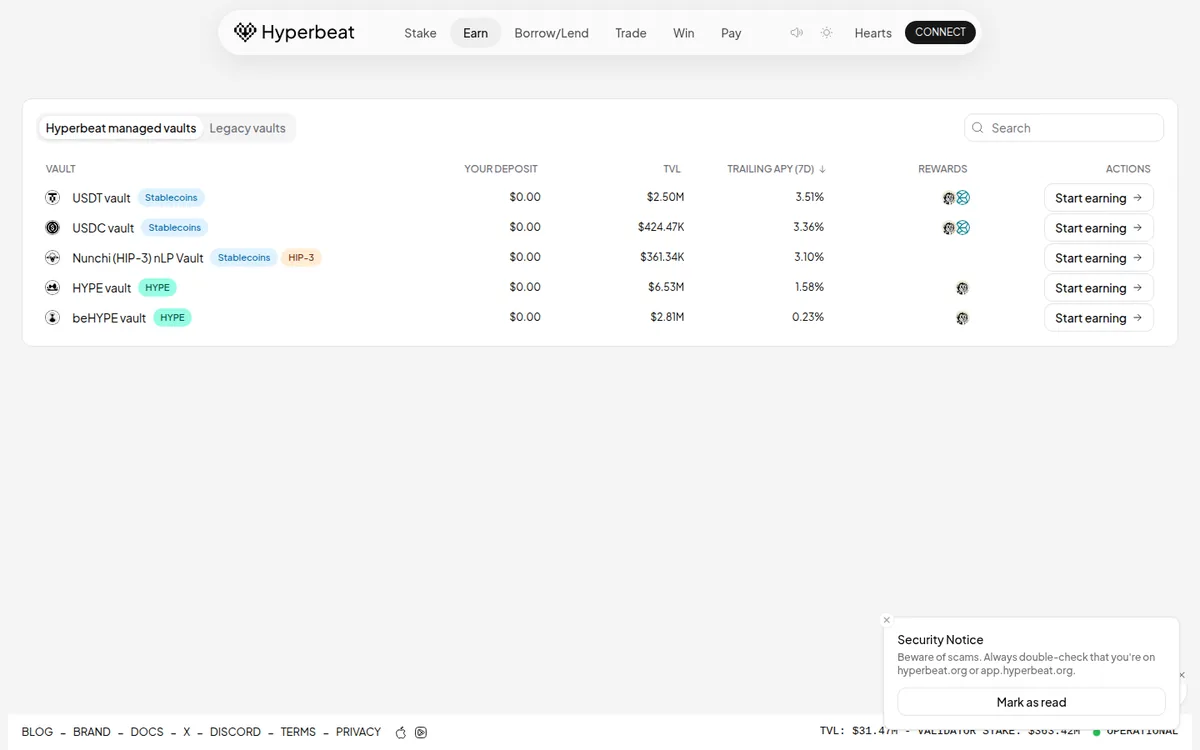
Hyperbeat Card homepage - live capture 2026-10-04
Hyperbeat is the yield infrastructure of the Hyperliquid ecosystem - beHYPE liquid staking, Earn vaults on HyperEVM, and since April 2026 a consumer layer called Liquid Banking [1]. The team raised a $5.2M seed in August 2025 co-led by ether.fi Ventures and Electric Capital [5]. The card is Hyperbeat Pay: a Visa where your assets sit in a self-custodial smart wallet (a ManagementAccount with Turnkey passkeys), and the card operator can only settle up to an on-chain allowance you define - it cannot seize funds [1]. Spending works two ways: Cash Mode settles from your beatUSD/USDC balance, and Credit Mode JIT-borrows beatUSD against BTC, ETH, SOL, HYPE or beHYPE collateral in dedicated Morpho Blue markets at conservative LTVs of 45-50%, so you spend without selling while collateral keeps earning [1]. Issuance is Third National under Visa - the same concentration point as its Rain-stack siblings [1]. The contracts are audited by Zellic and Nethermind [1]. The virtual card is live; the physical card sits on a waitlist [1].
Fees & Costs
The honest headline is that Hyperbeat publishes no fee schedule - no cardholder agreement is linked from the public site, and a docs-ask confirmed the absence [1]. The only figures available come from DefiLlama: FX 0.4-1% and ATM $1 plus 0.65%, which matches the convention of its sister cards on the same issuer [4]. For a card that wants institutional credibility, this documentation gap is the biggest structural criticism [1].
KYC & Onboarding
Account creation is deliberately paperless - email and a passkey - but the card itself requires identity verification "in under 5 minutes" per the App Store listing, and the credit modes require two approved services plus a one-time operator authorization [2]. No public KYC policy page exists, so the data collected and retention terms are not documented [1]. Availability covers 50 countries including the US, with no EU/EEA, UK or Canada [4].
Coins & Top-up
Funding runs through the self-custodial Liquid Bank account on HyperEVM: native deposits of BTC, ETH, SOL, HYPE, USDC, USDT and 15+ assets from any major chain, WalletConnect, or bridging from Arbitrum, Base and Ethereum [2]. Fiat rails include ACH, FedWire and SEPA, each account gets its own IBAN [1]. The on-chain settlement model is the distinguishing feature: the Operator can only settle up to the user-defined contract-level allowance, and cannot seize funds [1].
Rewards
Two layers. The everyday layer starts at 0.2% and reaches 1.0% only through four boosters - holding $1,000 or $10,000 in collateral and spending $1,000 or $10,000 in a rolling 30 days each add 0.2% [3]. The trading tiers pay 3-12% but require $1M-$50M of rolling 30-day trading volume on the platform, with per-tier spend caps that blunt the headline rate (the 3% tier caps qualifying spend around $3,300 per the blog's own example) [3]. Campaign cashbacks have run (5% on Apple purchases in September 2026) [3]. Rewards pay in WHYPE per DefiLlama - a volatile ecosystem token [4].
Reliability & Red Flags
Two material concerns beyond the documentation gap. First, operator opacity: the operator is Zoeion Ltd Corporation with a Panama care-of address, and registry evidence was not obtainable [1]. Second, a copy-paste artifact in the Terms - "The Issuer is not a party to any agreement with Ether.Fi protocol" - which suggests template reuse from ether.fi's program rather than bespoke legal drafting [1]. The issuer concentration (Third National/Rain) means this card inherits the same August 2026 infrastructure exploit context as Tria and Avici [1]. Community signal is effectively absent in the sources we could reach [1].
Verdict
The mechanics are genuinely novel - on-chain settlement with a user-set allowance, audited contracts, and spend-without-selling credit against Hyperliquid-ecosystem collateral [1]. But the fine print is missing: without published fees, terms or cashback rules, you are trusting the app's current behavior [1]. The realistic everyday rate is 0.2% at base and 1.0% maxed via boosters [3]; the 3-12% tiers belong to heavy traders [3]. Because the operator publishes no fee schedule or terms, the fact set is not fully verified - DefiLlama is the source of record for the fee figures [1][4]. For Hyperliquid natives the card is a credible spend-from-vault tool; for everyone else, better-documented siblings on the same issuer exist [1].
What works
True self-custody: assets sit in a user-owned smart contract wallet; the card Operator can only settle up to a user-defined on-chain allowance and cannot seize funds
Spend without selling: Credit Mode borrows beatUSD against BTC/ETH/SOL/HYPE/USD+ collateral at tap time; collateral keeps earning yield; conservative LTVs (45-50%)
Issuer and network confirmed in the public Terms (Third National, Visa license); Liquid Bank contracts audited by Zellic and Nethermind
Serious backers: $5.2M seed co-led by ether.fi Ventures and Electric Capital, with Coinbase Ventures and Anchorage Digital participating
Rich funding options: native BTC/ETH/SOL deposits, 15+ assets, ACH/FedWire/SEPA with own IBAN, SWIFT added Sept 2026
Generous default monthly spending limit ($100,000 per DefiLlama) and user-configurable card controls (PIN, freeze, spend cap)
Cashback rate structurally cannot be 'nerfed' - it scales with the user's own trading activity rather than a marketing budget
What to watch
No published fee schedule, cardholder agreement, cashback terms or country list anywhere public - DefiLlama is the only source for FX/ATM figures
Everyday cashback is thin: 0.2% base, 1.0% maximum requires four boosters ($1k-$10k balances AND $1k-$10k rolling 30-day spend)
Trading-volume tiers (3%-12%) require $1M-$50M rolling 30-day trading volume, with per-tier spend caps that blunt the headline rate
Full identity verification required for the card; card product restricted to verified accounts; US access gated by a U.S.-specific cardholder agreement not publicly linked
No EU/EEA, UK or Canada availability per the DefiLlama country list; physical card still on waitlist (announced Apr 2026, 'ordering available very soon' as of Sep 1, 2026)
Operator entity Zoeion Ltd Corporation has no published jurisdiction/address (Panama address only via Google Play registration)
Legal terms carry an ether.fi copy-paste artifact ('Issuer is not a party to any agreement with Ether.Fi protocol'), suggesting an adapted template
Young product (app v1.0 July 2026) with minimal independent community coverage; no third-party reviews found
Fee reality check
Issuance
Operator publishes NO public fee schedule: docs (docs.hyperbeat.org) do not state FX/ATM/issuance/monthly fees (confirmed via GitBook docs-ask query: 'FX fee: Not stated. ATM withdrawals: Fees not stated. Monthly or issuance fees: Not stated.'). Fee figures below are DefiLlama (secondary source) values.
FX fee
1%
ATM fee
0.65% + $1 per withdrawal
Fine print
DefiLlama row (snapshot 2026-10-03): FX '0.4%-1%', ATM '$1 + 0.65% per withdrawal'. Same Rain-stack convention as sister cards (Ethena Pay: FX = Visa at cost ~1% no markup; ATM $1.00 + 0.65%). Hyperbeat terms contain no fee schedule; cardholder agreements referenced but not linked from the public site. Physical card described as 'delivered free' in a campaign blog. App Store confirms user-set spending caps and no fee mentioned for card issuance.
Three steps, based on the operator-documented facts in this review (fact status: checked 2026-10-04):
Sign up. full identity verification is required at signup.
Top up. Native top-up coins are not documented in our research. Load fees are in the fee table above.
Spend or withdraw. a virtual card for online payments. ATM withdrawals are not documented - treat it as a spend card unless the operator states otherwise.
Check your country. Documented region: UAE, Antigua & Barbuda, Argentina, Australia, Barbados, BD, Bolivia, Brazil, Bahamas, Belize, Ivory Coast, Colombia, Costa Rica, Dominican Republic, Ecuador, EG, Grenada, Ghana, Guatemala, Guyana, Hong Kong, Honduras, Japan, Kenya, St Kitts & Nevis, Cayman Islands, St Lucia, Morocco, Mexico, Malaysia, Nigeria, New Zealand, Panama, Peru, Philippines, Pakistan, Paraguay, Singapore, Senegal, Suriname, El Salvador, Turks & Caicos, TH, Trinidad & Tobago, Uganda, USA, Uruguay, St Vincent, South Africa, Zambia. Run the region checker for exclusions named by the operator.
Based on our checks as of 2026-10-04: Hyperbeat Card scores 5.1/10 in our weighted review. We logged 5 red flags (listed above). User reports and the operator background are documented with dated sources in the meta-review below.
The meta-review: what the internet says about Hyperbeat Card
We do not expect you to trust us. This review is a meta-review: below you see what other review sites claim, what users report on Reddit and forums, and who actually operates Hyperbeat Card - including the issuing structure behind the card. Every claim links to its source so you can verify it yourself. Our verdict forms from these sources plus our own fact checks - not the other way around.
What other reviewers say
Heads-up: most crypto card "reviews" are affiliate content. We mark our reliability judgement on every source and include critical voices deliberately.
No third-party reviews with usable evidence found yet. In this niche that is itself a signal - most "review" sites are affiliate placements.
What users say (1)
Reddit, forums, complaint boards. Anecdotes, not proof - but patterns across threads are the best early-warning system this industry has.
NO INDEXED COMMUNITY SIGNAL: arctic-shift posts search for subreddit=Hyperliquid&query=hyperbeat returned {'data': []} (empty) after repeated attempts (other queries hit 'Timeout. Maybe slow down a bit'); site-wide query requires a subreddit parameter; pullpush.io returned 'error code: 502'. No scam/theft/rug reports found anywhere in fetched operator/store material; Google Play shows 8 reviews (4.2 stars) with no complaints beyond a login gripe; App Store 2 ratings 5.0 ('The best finance app I have ever used', 27 Jul). Community coverage is effectively absent - too new/too niche. http_status 200/502 recorded per call, 2026-10-04.
Who is behind Hyperbeat Card?
Card programs stand and fall with their operator and BIN sponsor. This is what we could verify - with sources. Confidence: confirmed (checked 2026-10-04).
Operator
Hyperbeat (Liquid Banking / Hyperbeat Pay)
Legal entity / issuer
Zoeion Ltd Corporation (platform operator per Terms of Use; app seller 'Beater FND' on the App Store, developer Zoeion Ltd Corporation with a Panama service address on Google Play: 'C/O Paralelaw PH Iver 77, C. Jose Matilde Perez 01, Panama'). Card issued by Third National (the Nimbus LLC d/b/a Third National entity of the Signify Holdings 'Rain' group, same issuer-of-record as Ethena Pay, Avalanche Card and KAST - Hyperbeat's own Terms name only 'Third National') pursuant to a license from Visa. Incorporation jurisdiction of Zoeion Ltd: not published.
Registered in
Not published (Panama address on Google Play developer registration; 'Worldwide' on X profile)
Hyperbeat started (Aug 2025, $5.2M seed co-led by ether.fi Ventures and Electric Capital) as the yield infrastructure layer of Hyperliquid: beHYPE liquid staking, Hyperbeat Earn vaults on HyperEVM (USDT/USDC/HYPE/uBTC/XAUt/HIP-3 vaults), delta-neutral dnTokens, Morphobeat credit markets, BeatPot, MasterSwap. In April 2026 it launched 'Liquid Banking': a self-custodial smart wallet (ManagementAccount, UUPS-upgradeable, Turnkey passkey key management) on HyperEVM combining global account (own IBAN, ACH/FedWire/SEPA/SWIFT), savings (USD+), 24/7 trading (spot/perps/equity perps/gold, up to 40x), and the Hyperbeat Pay Visa card. The card is a Rain-stack white-label: Terms name Third National as Issuer 'pursuant to a license from Visa'; Rain program management is not stated in Hyperbeat's own materials (inferred from the issuer + the ether.fi artifact sentence; 'reported', not confirmed).
Every external source used on this page, with the date we fetched it. Methodology: how we verify. Sources disappear or change - if a link is dead, tell us via contact. Quoted text is the verbatim excerpt this review cites.
“The card is issued by Third National under license from Visa. If you set a limit of $1,000, the Operator's request to settle cannot exceed that on-chain allowance. The Issuer is not a party to any agreement with Ether.Fi protocol.”
“Deposit over 15 crypto assets from any major blockchain, including USDC, USDT, ETH, BTC and SOL. Set your own spending limit. Verify your identity in under 5 minutes to unlock your card.”
“0.20% base on all card spend; four boosters (Holder $1,000, Holdmaxxer $10,000, Spender $1,000 rolling 30-day spend, Spendmaxxer $10,000) each add 0.20% for a maximum 1.0% everyday rate. Trading tiers from 3% at $1M volume.”
“FX 0.4%-1%, ATM $1 + 0.65% per withdrawal, cashback 0.2% base; up to 1% everyday; 3%-12% by trading volume with rolling 30-day spend caps, issuer Third National, self-custodial.”
“Hyperbeat raised a $5.2M seed in August 2025, co-led by ether.fi Ventures and Electric Capital (headline via RSS; page blocked to our infrastructure).”
accessed 2026-10-04 · HTTP 403
Rate Hyperbeat Card
Community score: no ratings yet
One rating per user and card. Smoothed display (statistical prior) prevents single-vote manipulation.
User comments (0)
No comments yet - be the first. No account needed; the anti-spam proof runs in your browser.
A credible, well-backed self-custodial spend card with genuinely low fixed costs ($0 monthly/issuance/shipping, 0% APR) and true on-chain collateral custody in smart contracts. But it is not a privacy product (full KYC with SSN/national ID, GLBA data sharing), the rewards program is opaque (earn rates only in-app, statement-credit redemption at 70% of face), international FX is 'up to 3%' with a 1%-vs-2% disclosure conflict on the US side, and spending limits can be cut at Rain's sole discretion - with liquidation possible 'without prior notice'. Best for AVAX/stablecoin holders in the US (partial) and Latin America/Caribbean who want to spend against their stack; not for no-KYC users, and international terms (1-day payment window) behave much harsher than the US 21-day credit cycle.
Phantom Cash finally gives the biggest Solana wallet a spending rail: a free virtual Visa paid out of a CASH stablecoin balance with Apple/Google Pay and yield on idle balances. But it is a US-only (ex-NY), virtual-only product with a USD 2,000 standard daily cap, 1.75% card funding and no card cashback - a nice extension of the wallet, not yet a full card program.
The most complete self-custodial spending stack in this comparison: your own vault plus real bank rails in four currencies (ACH, SEPA, GBP FPS, Swiss IBAN), 3% ETHFI cashback on the first $2,000/mo with Category and 5% travel boosts, KYC light in practice (ID + liveness; proof of address only on request - verified first-hand September 2026 with a Paraguayan cedula and a German passport) and an uncapped public affiliate program. The documented risks are real: interest from the first tap in Borrow Mode, liquidation risk, the November 2025 fraudulent-card incident with promised refunds, a protection program still marked not yet live that excludes compromised keys, and cashback now locked in volatile ETHFI instead of instant USDC.



No comments yet - be the first. No account needed; the anti-spam proof runs in your browser.