The most mainstream way to hold BTC next to a Visa debit - but the card itself never touches bitcoin: every spend requires selling first, which is a taxable event per transaction. Use it for the Boosts and the frictionless BTC auto-investing, not for crypto-native spending.
site reachable (bot-protected) · checked 16 h ago · daily check
Review
by the cryptodebitcards editorial desk · review version 3 · prose updated 2026-09-21 · facts as of 2026-09-21 · how we verify
Overview
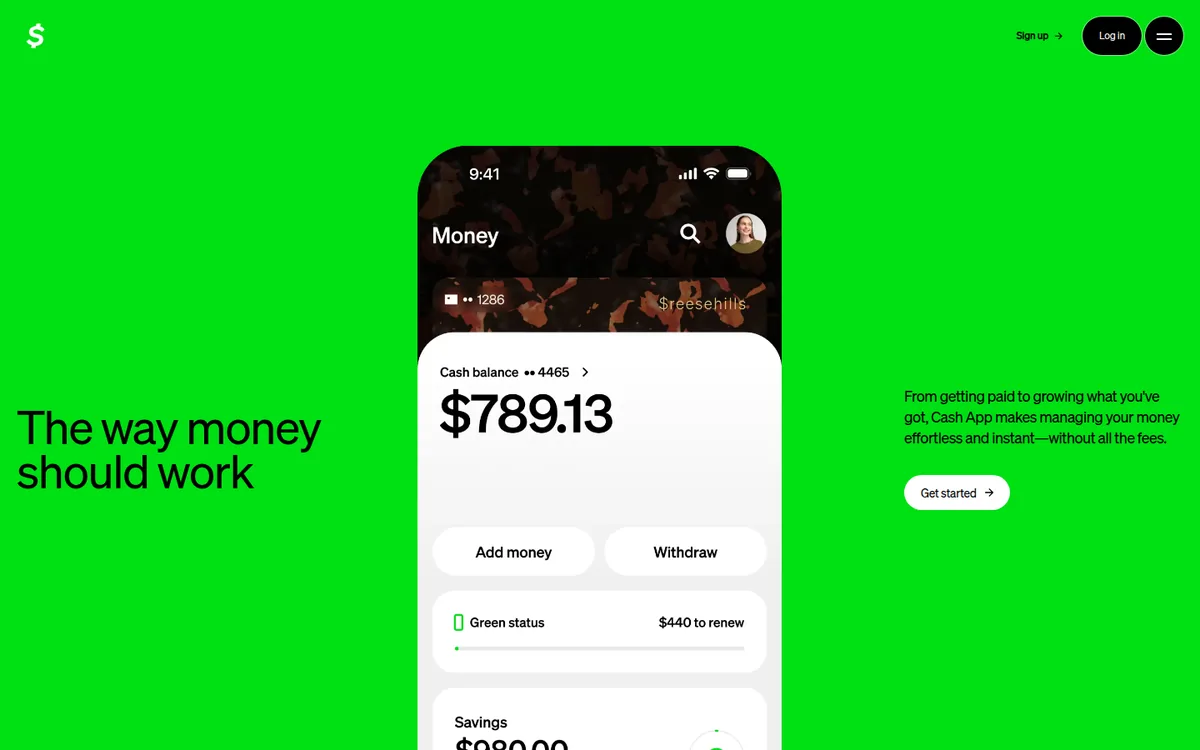
Cash App Card homepage - live capture 2026-09-19
The Cash App Card is a Visa debit card offered by Cash App, a fintech provider. It is available in both physical and virtual form factors and is designed for users in the US and UK. The card spends USD only, and bitcoin can be converted to USD via manual in-app sells.
Fees & Costs
The Cash App Card has no monthly fee, issuance fee, or top-up fee. The foreign transaction fee is 3%, but it can be waived for card-present transactions with $300+/month qualifying deposits or $500+/month qualifying purchases. ATM withdrawals incur a $2.50 fee, although this can be reimbursed for in-network withdrawals with qualifying deposits or purchases. Other fees, such as inactivity fees, have not been verified.
KYC & Onboarding
The Cash App Card requires full KYC, including identity verification and, for banking features, a Social Security Number (SSN) for US users. The ordering process and shipping time have not been verified.
Coins & Top-up
The Cash App Card supports bitcoin conversion via in-app sells, with Lightning receiving enabled. Bitcoin held in-app must be sold to USD before spending. The minimum top-up amount has not been verified. Paycheck deposits can be auto-split into cash and bitcoin.
Rewards
The Cash App Card offers rotating instant discounts, known as 'Boosts', at selected merchants, including occasional bitcoin-back offers paid in BTC to the Cash App wallet. There is no fixed cashback percentage, as offers vary per user.
Reliability & Red Flags
Cash App, the operator, has a reputation as the largest consumer bitcoin app in the US. There have been no card-specific incidents reported. However, a recent settlement with 46 states and the CFPB has led to Block paying $45M over misleading fraud-protection marketing. Reddit reviewers have also reported issues with bitcoin withdrawal holds. The data quality is reported, but not fully verified.
Verdict
The Cash App Card is a mainstream fintech card with crypto features on the side. It is suitable for users looking for a convenient way to hold and spend USD, with the option to convert bitcoin to USD for spending. However, the card itself does not support crypto-native spending, and users should be aware of the taxable event per transaction when selling bitcoin.
What works
Largest US consumer bitcoin platform (Block/NYSE-listed)
Visa debit with instant-issue virtual card, Apple/Google Pay
BTC auto-splits from paycheck deposits, Lightning receiving supported
Boosts program incl. bitcoin-back rewards
What to watch
Card spends USD only - BTC requires manual sell per spend (taxable each time)
BTC sells carry spread + volume-based fees
Full KYC; US/UK only (card US)
Not a crypto card in the native-spending sense
Fee reality check
Monthly
none
Top-up fee
0%
FX fee
3%
ATM fee
0%
Fine print
Cash App Card fee schedule (cash.app/legal/us/en-us/card-agreement, current terms captured 2026-06-05): Monthly fee $0, per-purchase fee $0, adding cash to the card from the Cash App balance $0, inactivity $0; foreign transaction fee 3% (waived on card-present transactions with $300+/mo qualifying deposits or $500+/mo qualifying purchases); replacement card $5 classic / $50 metal. Note: the previous long-form disclosure (captured 2025-12-10) still showed a 2% foreign transaction fee - the current agreement is 3%. BTC sells in-app carry a spread plus volume-based fee before spending.
Based on our checks as of 2026-09-21: Cash App Card scores 6.6/10 in our weighted review. We logged no red flags. User reports and the operator background are documented with dated sources in the meta-review below.
Is KYC required?
Yes, full KYC is required, including identity verification and SSN for US users.
What fees does it charge?
The card charges a 3% foreign transaction fee, $2.50 ATM withdrawal fee, and other fees as outlined in the card agreement.
Which coins can you load?
Bitcoin can be converted to USD via in-app sells, but not loaded directly.
Does it pay cashback?
The card offers rotating instant discounts, known as 'Boosts', including occasional bitcoin-back offers.
Which regions does it serve?
The card is available in the US and UK.
Is it safe/legit?
Cash App has a reputation as a legitimate fintech provider, but users should be aware of the recent settlement over misleading marketing.
Is the card physical or virtual?
The card is available in both physical and virtual form factors.
The meta-review: what the internet says about Cash App Card
We do not expect you to trust us. This review is a meta-review: below you see what other review sites claim, what users report on Reddit and forums, and who actually operates Cash App Card - including the issuing structure behind the card. Every claim links to its source so you can verify it yourself. Our verdict forms from these sources plus our own fact checks - not the other way around.
What other reviewers say
Heads-up: most crypto card "reviews" are affiliate content. We mark our reliability judgement on every source and include critical voices deliberately.
No third-party reviews with usable evidence found yet. In this niche that is itself a signal - most "review" sites are affiliate placements.
What users say (2)
Reddit, forums, complaint boards. Anecdotes, not proof - but patterns across threads are the best early-warning system this industry has.
'Do you have the new cash app card for afterpay if so you have to turn it on for afterpay to go thru' - user-to-user help referencing the current card stock; confirms the Cash App Card is still shipping and now ties into Block's Afterpay integration.
Fresh BTC-specific complaint: a Cash App on-chain bitcoin withdrawal held 'under review' beyond the promised timeframe (posted twice the same day; body removed). Confirms the BTC withdrawal feature is live - and that review holds are a current user pain point.
Who is behind Cash App Card?
Card programs stand and fall with their operator and BIN sponsor. This is what we could verify - with sources. Confidence: medium (checked 2026-09-18).
Operator
Cash App (Block)
Legal entity / issuer
Block, Inc. (NYSE: XYZ); Cash App Card issued by its partner bank (Sutton Bank, Member FDIC, per product documentation) - card issuer detail to re-verify at signup (product pages 403 to datacenter crawlers)
Registered in
United States
Largest US consumer BTC app; banking features via partner banks.
Generated by Llama on 2026-09-21 from our fact database plus the 7 linked sources above. It summarizes - it does not add facts. Check anything that matters against the linked sources.
Bottom line: The Cash App Card is a Visa debit card that spends USD only, with bitcoin conversion available through manual in-app sells. It is a mainstream fintech card with crypto on the side, suitable for those who want to hold BTC next to a Visa debit. However, the card itself never touches bitcoin, and every spend requires selling first, which is a taxable event per transaction.
The fee reality: The card has no monthly fee, no per-purchase fee, and no fee for adding cash to the card from the Cash App balance. However, there is a 3% foreign transaction fee, a $2.50 ATM withdrawal fee, and a fee for replacing the card. Some fees can be waived with qualifying deposits or purchases.
KYC and coins: The card requires full KYC, including Cash App identity verification and SSN for banking features. It supports bitcoin conversion, but not native crypto spending. Bitcoin held in-app is not spendable directly and must be sold to USD first.
What reviewers say vs what users say: There are conflicting views on the card, with some users complaining about issues like bitcoin withdrawal holds, while others find the card useful for its features like Boosts and frictionless BTC auto-investing. Reviewers note that the card is suitable for mainstream users who want to hold BTC next to a Visa debit, but may not be ideal for crypto-native spending.
Who issues it: The Cash App Card is issued by Sutton Bank, a partner bank of Block, Inc., the operator of Cash App. Block, Inc. is a US-based company listed on the NYSE.
Sources & how this review was built
Every external source used on this page, with the date we fetched it. Methodology: how we verify. Sources disappear or change - if a link is dead, tell us via contact.
The cleanest bitcoin-rewards credit card structure on the market: flat 1.5% in BTC with no cap and no annual fee, up to 4% for engaged users. It is a credit product - bureau checks and reporting apply, and the variable APR punishes carried balances.
The reference bitcoin-back debit card in the US: sats on every swipe, FDIC pass-through on the dollar balance via Sutton Bank, BitGo custody and a Nasdaq-listed parent. Rewards are variable-rate spins rather than a fixed percentage - treat the sats as a bonus, not a yield.
The most complete dual-mode card: one tap switches between spending your crypto (Debit, with daily interest) and borrowing against it (Credit, from 1.9%) - with free ATM allowances up to EUR 2,000/month and no card fees. The catch: meaningful cashback needs a $5,000+ portfolio and is denominated in NEXO, and it is EEA/UK-only.
Full KYC2% backphysical card
0% load · 0.2% FX · 2% back in NEXO
Higher limits via Nexo Private ($100,000+ assets)Fintech 3 d ago




No comments yet - be the first. No account needed; the anti-spam proof runs in your browser.