Every card you can load directly with Bitcoin - Lightning or on-chain, without an exchange in between.
Short answer:ether.fi Cash is our top-rated Bitcoin debit card as of 2026-11-07 (7.6/10), Basic KYC, 0% load fee.
cards on this page: 15 · issuing today (excl. watch list): 11 · independently verified facts: 47% · no KYC at first use: 20%
quick picks
spend bitcoin without a custodial balance→ether.fi Cash - liquidBTC sits in your vault as collateral - the card borrows, no conversion happens until you choose it
bitcoin top-ups without identity friction→Goblin Card - BTC native at 3.5% load with 0% FX and no KYC - the fastest BTC-to-spending path in the set
The most complete self-custodial spending stack in this comparison: your own vault plus real bank rails in four currencies (ACH, SEPA, GBP FPS, Swiss IBAN), 3% ETHFI cashback on the first $2,000/mo with Category and 5% travel boosts, KYC light in practice (ID + liveness; proof of address only on request - verified first-hand September 2026 with a Paraguayan cedula and a German passport) and an uncapped public affiliate program. The documented risks are real: interest from the first tap in Borrow Mode, liquidation risk, the November 2025 fraudulent-card incident with promised refunds, a protection program still marked not yet live that excludes compromised keys, and cashback now locked in volatile ETHFI instead of instant USDC.
The most complete no-KYC crypto card we track: instant virtual Visa, Lightning Address top-ups, Tor support, working ATM withdrawals via Google Wallet NFC, responsive multilingual support and a year of positive user reports with no documented incidents. The fee stack is honest and the 1.3% load is the cheapest in the no-KYC niche. Counterparty risk stays material - the issuer is undisclosed, the operator is a self-declared Delaware LLC at a registered-agent address, balances are custodial with no way back on-chain, and even a chargeback demands KYC and $250. Treat it as a spending pipe: top up, spend, replace.
best no-KYC pickNo KYCLightningXMR direct
1.3% load · 2.5% FX · no cashback
$5,000 (Founder/HODL); $10,000 (MOON, announced)★★★★☆4 (1)Crypto-native 40 h ago
The most mainstream way to hold BTC next to a Visa debit - but the card itself never touches bitcoin: every spend requires selling first, which is a taxable event per transaction. Use it for the Boosts and the frictionless BTC auto-investing, not for crypto-native spending.
The only true bank in this comparison: a Gibraltar credit institution with deposit-guaranteed USD, savings interest paid daily in BTC (USD Savings 4.1% APY since 22 Sep 2026), worldwide metal card spending with no FX fees and high limits. But the general card cashback ended in July 2026 (now a taxi-only 3% campaign for Metal members), the $1,000/year membership makes it a wealth product, and crypto balances are NOT deposit-covered.
A US-registered, SOC-2-accredited exchange card with true point-of-sale crypto conversion - pick any listed coin as your spend wallet and it converts at the tap. The exchange and token ecosystem are mid-sized; the mechanism is the appeal.
The Nuri relaunch is a self-custodial wallet (Euros, Dollars, Stablecoins, Bitcoin) with a free Visa card on Wirex BaaS infrastructure - operator verifiable (Nurisoft Development OÜ, Tallinn), card wallet self-custody, GBP 30,000 limits. But no official statement connects it to the insolvent 2022 Nuri GmbH, and the fee schedule hides in the Wirex layer. Verify card terms before loading.
The strongest physical no-KYC card pitch: a real Mastercard with ATM access, 0% FX and 0% ATM fees, XMR deposits and privacy-preserving support channels. The trade-offs are a $350 entry price, 3.5-4% deposit fees and an unlicensed custodial balance - treat it as a privacy tool, not a bank account.
A Ledger-branded Visa prepaid card by Baanx that lets users spend from Ledger self-custody, converting crypto to fiat at the moment of purchase and paying 1% cashback in BTC (2% in BXX). Live across UK/EEA plus a 2025 US expansion, but the open jurisdiction list is login-gated and the old Ledger shop pages are dead links.
A Monero-capable virtual Mastercard with Apple/Google Pay support and $10-$10,000 loads - a rare direct-XMR card. Until fees, limits and the operator behind it are verifiable, treat it as an unverified lead: fund only what you can afford to lose.
A niche virtual-card tool for online media buying with crypto funding - now with a named operator (ADV Summit Advisors Limited, TCI) and documented fees. Usable for its purpose, but the 3% cashback is a Private-subscription ad-spend benefit paid as subscription credit, and the regulated issuing side remains unnamed. Poor as a general spending card; keep balances minimal.
A documented, fully-priced stablecoin Visa program with named regulatory registrations - but unresolved mega-litigation changes the risk picture: Binance sued RedotPay and its founders for ~$472.8M in August 2026 over alleged user-asset diversion. Custodial balances, freeze powers, no named issuer. Treat as usable-but-contested; keep balances minimal and watch the litigation.
Kolo Card is a genuinely live product: a virtual Visa Platinum debit card (EUR card since 1 Jul 2026, issued by Wirex Ltd UK; USD card issued by Banco Popular de Puerto Rico), issued through Rain Cards infrastructure on top of an MPC wallet that is closer to self-custody than a typical omnibus wallet - but Kolo still co-signs and can decline for compliance reasons, so it is hybrid in practice. The fee stack is the weak spot: 1% on every card payment plus tiered Visa FX surcharges plus an extra 1% USD-card issuer fee, against an ongoing 1% BTC cashback with $1/purchase and $100/month caps - meaningfully less attractive than the headline suggests once the promo window ends. Country eligibility is opaque (60+ claimed, list not published; US excluded). Track record is short with entity churn and a deleted status page, but no scam reports and active development. Best suited to EUR-area stablecoin holders who want same-currency euro spending with BTC stacking; a poor fit for anyone expecting the promo-era 5% or uncapped cashback to persist.
A Visa prepaid card integrated with the Blink Lightning wallet: cardholders fund a Card Balance from the wallet (default custodial 'Funded Mode', with a non-custodial option) and any BTC balance is converted to USD at the moment of each transaction. Issued in Puerto Rico with a Honduras-Próspera tech provider; fees and open jurisdictions are only visible in the app.
Watch - do not load funds. Trustpilot reviews (Jan 2026 snapshot, 254 reviews, 2.9 score) document cards canceled en masse on 2025-11-30 with refunds stalled, while the marketing site (Sept 2026 snapshot) still promotes the card and developer docs stayed active (Aug 2026). KYC claims conflict: official email-only wording vs user-forced Sumsub re-KYC. Not a loadable card until refunds and issuance demonstrably resume.
The card program continues under Volet after the 2024 AdvCash rebrand - active product development, documented fee tables, tiered KYC (wallet without ID, cards with). Offshore positioning (Belize licence, Canada incorporation) and the documented complaint pattern around frozen legacy cards keep it a watch-adjacent niche tool rather than a recommendation.
15 programs take bitcoin natively, and every one of them answers the same question differently: when the card is tapped, what actually sells? Convert-at-load programs create one taxable event per load [3]; per-tap architectures create one per purchase; collateral models (ether.fi's liquidBTC) defer everything until you choose. The question is not academic - it decides your record-keeping, your lot accounting, and how you think about a balance. It also decides who carries price risk between your purchase and the settlement: the architecture that feels most convenient is usually the one that moved risk to a counterparty you did not price. This page maps the architectures, the rail economics, and the exit file that justifies the small-balance discipline.
The tax architecture: load-time conversion versus per-tap disposal.
The on-chain versus Lightning decision
5 of the programs here accept Lightning top-ups, and the network behind them is real infrastructure: roughly 19,800 public channels and ~2,690 BTC of capacity (1ml.com, 2026-10-01). The measured numbers frame the choice: on 2026-10-01, on-chain fees sat at 1-2 sat/vB, putting a 150-vB load at $0.13-0.25 [4] - cheap by historical standards, volatile by design. Dust policy floors the minimum on-chain load at 294-330 sat of output value [7]. Lightning inverts the profile: milliseconds to settle, per-hop fees that round to nothing, no confirmation window - which is why the Lightning-native programs accept top-ups that would be irrational on-chain. 5 of the programs here support Lightning; the Lightning hub holds the mechanics and the network numbers.
The rule that survives every fee regime: rail by load size. Lightning for the small, frequent, impatient top-ups; on-chain for the monthly large load where a flat fee is noise and Lightning channel liquidity is not assured. Programs that accept both (Freedomia's nine-plus chains including BTC and BTC-LN) let the decision happen per load - the chain menu is the real feature.
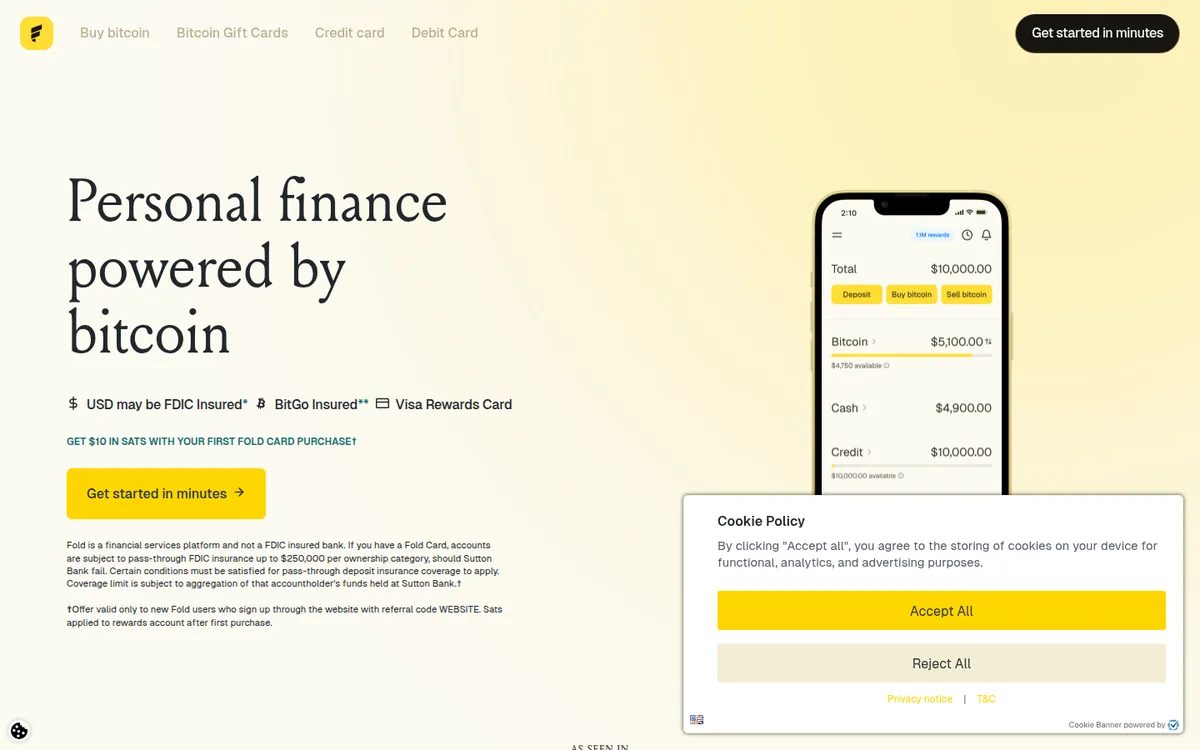
Fold, live capture - the bitcoin-native stack: debit card by Sutton Bank, credit card by Celtic Bank, rewards in sats.
The tax architecture, precisely
The IRS FAQ is the anchor: exchanging crypto held as a capital asset for other property, goods or another virtual currency recognizes gain or loss [3]. The principle is old (property-for-property exchange), but its application to a card that converts invisibly at the terminal is what makes the architecture choice a tax decision first and a product choice second. Three consequences follow. A custodial card that converts at load creates one lot per load - clean records, one calculation per load, no per-tap events after. A per-tap program creates a lot per purchase - the price of no stored balance is continuous lot tracking, which tax software handles but only if the transactions export cleanly. And reward sats are a third thing: the conservative reading treats them as income at claim, which is why they belong in a separate mental account from loaded fiat. The tax guide covers the US and EEA patterns.
One more records note that saves hours at filing time: export the card's transaction history monthly, not at year-end. Per-tap programs generate hundreds of small disposals; reconstructing them from statements later is the worst version of the job, and the programs' export formats are exactly as good as their APIs - which is to say, uneven. The users whose BTC-card taxes are painless are the ones whose records never needed reconstruction.
Live values from our database - details and caveats in each review. "-" = not published by the operator.
The exit file - why balances stay small
This is the section that justifies the whole page's balance discipline, so it gets the numbers: the documented exits are not edge cases - they are the known failure modes of exactly this product class, and they cluster in the BTC-native corner of the market where programs are smaller, newer and less interchange-subsidized than their stablecoin cousins. Three of them define the risk. VAST Bank: an OCC-regulated bank exited crypto banking entirely, disabled the app, and liquidated remaining balances - a bank licence was no protection once the product lost institutional support [5]. OneKey Card: an orderly three-phase sunset ending January 2025, balances withdrawable throughout - the good version of the same event [6]. Binance Card: the network ended the program in its main regions in December 2023, with the 2026 relaunch confined to Latin America [9]. The shared pattern is the argument for load-frequent-small: in every exit, the balance became a process (payout queue, withdrawal window, liquidation notice) rather than money you could spend.
Warning: The exit file is not history - it is the base rate. Programs that take BTC natively skew toward smaller operators and newer sponsors, and the virtual hub documents how BIN-sponsor failures work. The self-custody architectures (ether.fi's vault) remove the balance-side exposure; the format cannot remove the card-side one. The practical synthesis across every exit on file: the users who came through unscathed were the ones whose balances were small by policy, not by luck - the withdrawal windows and payout queues reward preparation, and there is no way to prepare after the announcement.
Choosing from the ranking
9 of 15 programs charge no monthly fee; 3% is the best card reward rate in the population; 13% run self-custody architectures; and 47% of the fee data here is independently verified - the lowest share in our comparison set, because BTC-native programs skew small and new. That number is part of the balance-sizing math, not a footnote.
The shortlist by profile: Bitcoin holders who want spending without selling - the collateral model, where liquidBTC stays yours as collateral [see the self-custody hub]. Accumulate-while-spending - Fold's stack, where the debit and credit cards both pay in sats [1][2]. Small no-friction top-ups - the Lightning-native and no-KYC programs, with their documented trade-offs. Stablecoin-first users who occasionally fund in BTC - the stablecoin hub explains why the two rails are not substitutes. And the structural note that closes the set: bitcoin on a card is a bridge product - the rails and the exit file, not the fee table, decide whether the bridge is one you want your money on.
When does spending bitcoin create a taxable event?
The IRS is explicit: exchanging crypto held as a capital asset for other property - including goods or fiat - recognizes gain or loss [3]. So the architecture decides the record-keeping: convert-at-load cards create one disposal per load at that moment's rate; per-tap architectures create a disposal on every purchase. Same economics, very different record-keeping - the tax guide walks both.
What does an on-chain BTC load cost right now?
At 1-2 sat/vB (mempool.space, 2026-10-01), a 150-vB transfer costs roughly $0.13-0.25 [4]. The number moves with congestion - the historical range for the same transfer spans $2-15 - which is why the load-timing rule matters: check the fee market before large loads, and let Lightning take the small ones (dust thresholds floor on-chain minimums at 294-330 sat anyway [7]).
Is a custodial BTC "balance" actually bitcoin?
No. Once loaded and converted, it is the provider's fiat with your name on it - the BTC price stops mattering to you and the counterparty's solvency starts mattering. The [bitcoin-load tax figure](#bitcoin-tax-architecture-load-time-conversion-vs-per-tap-disposal) frames the trade: conversion at load fixes your tax lot and transfers price risk to the issuer. Cash App's own page states the 1:1 no-lending policy for its BTC holdings [8] - that is custody of the coin, which is different from conversion to fiat.
What is the exit file, and why does it matter here?
The documented deaths of bitcoin card products. VAST Bank (Oklahoma) disabled its crypto banking app and liquidated remaining balances after regulatory action (OCC cease-and-desist, capital ratio 4.75% vs 13% required) [5]. OneKey Card ran a three-phase sunset from September 2024 to full discontinuation in January 2025, with balances moved to a withdrawable wallet [6]. Binance Card exited the EEA in December 2023 (the LATAM program relaunched in 2026) [9]. The pattern: balances became a process, not a balance - the argument for load-frequent, store-never.
Can I earn bitcoin instead of just spending it?
Yes - that is Fold's model: the credit card pays 1.5% BTC back uncapped with documented bonus paths toward ~4%, and the debit side earns through wheels, boosts and roundups [1][2]. The conservative tax reading treats earned sats as income at claim [3]. The cashback hub compares the earn structures; this page covers the funding direction.
How does Lightning change the small-load math?
It removes the floor. On-chain, dust policy (294-330 sat minimums [7]) and flat fees make sub-$50 loads inefficient; Lightning moves small loads to milliseconds at per-hop fees that round to zero, which is why the Lightning-native programs (Freedomia, Cash App, Moon) can accept small top-ups that would be irrational on-chain. The Lightning hub covers the mechanics; the fee calculator prices your cadence.
Which programs take BTC natively?
15 on this page, from no-KYC cards (Goblin, Freedomia) to self-custody collateral (ether.fi's liquidBTC) to the US banking stack (Cash App, Fold). 5 support Lightning top-ups. The differentiation is not "BTC yes/no" but what happens at load - convert immediately, hold until tap, or collateralize - and the card pages name the architecture per program. Read the deposit-scan notes too: BTC deposits scan on-chain and Lightning differently, and a program that supports both runs two detection stacks behind one address field.
What does "we hold your bitcoin 1:1 and never lend it out" mean for me?
It is a custody promise, not an insurance policy. Cash App's language [8] means your BTC is not rehypothecated - but it is still a claim on the operator, not keys you control. The self-custody alternatives (ether.fi's vault model) remove the claim entirely; the trade is liquidation math for counterparty risk. The self-custody hub walks that trade.
Are there bank-chartered bitcoin cards?
That was VAST Bank's model - a nationally chartered bank running crypto banking alongside deposits - and its exit is the cautionary version: a bank licence did not protect the product from the regulator or the board [5]. The surviving bank-adjacent model is partner-bank issuance (Sutton, Celtic for Fold [1]), where the chartered bank issues the card while the fintech runs the bitcoin layer. The banks hub covers the charter-only exception.
How do I price a BTC card routine end to end?
Rail fee (on-chain $0.13-0.25 today, Lightning near-zero [4]), the program's load percentage, conversion timing (at-load vs per-tap), and the monthly fee. 9 of 15 programs here charge no monthly fee and the median load fee is ~0% - the rails and the architecture decide more than the fee table. The fee calculator takes your real numbers.