Cards built for the unbanked and the borderless - worldwide issuance, shipping and usage.
Short answer:Freedomia is our top-rated worldwide crypto card as of 2026-11-07 (7.2/10), No KYC, 1.3% load fee.
cards on this page: 19 · issuing today (excl. watch list): 13 · independently verified facts: 47% · no KYC at first use: 16%
quick picks
global reach without KYC paperwork→Goblin Card - GLOBAL/LATAM with 0% FX and $0 ATM - and a published restricted-countries list of ~50 entries that is the honest version of "worldwide"
global card on self-custody rails→COCA - claims 200+ countries and self-custody - but no issuer is named in public documents, so treat both claims as unverified
premium global banking with the subscription priced in→Xapo Bank - $1,000/year membership, no FX fees, $2,000/day ATM - the full-price version of "global", with the region list to match
The most complete no-KYC crypto card we track: instant virtual Visa, Lightning Address top-ups, Tor support, working ATM withdrawals via Google Wallet NFC, responsive multilingual support and a year of positive user reports with no documented incidents. The fee stack is honest and the 1.3% load is the cheapest in the no-KYC niche. Counterparty risk stays material - the issuer is undisclosed, the operator is a self-declared Delaware LLC at a registered-agent address, balances are custodial with no way back on-chain, and even a chargeback demands KYC and $250. Treat it as a spending pipe: top up, spend, replace.
best no-KYC pickNo KYCLightningXMR direct
1.3% load · 2.5% FX · no cashback
$5,000 (Founder/HODL); $10,000 (MOON, announced)★★★★☆4 (1)Crypto-native 40 h ago
The most complete stablecoin-spending account on the market: US/EU virtual bank accounts from anywhere, Visa Platinum cards with real 1.5% USD cashback on the free tier, instant cashback and no spending caps. Full KYC and a young operator are the trade-offs; the paid tiers only make sense for heavy spenders.
Full KYC1.5% backphysical card
0% load · 1.5% back in USD
Spend up to whatever is in your wallet - no hidden monthly spending caps (Premium cap <= $10,000/mo, Private <= $40,000/mo apply to cashback earn rates, not spending)Neobank 8 d ago
The only true bank in this comparison: a Gibraltar credit institution with deposit-guaranteed USD, savings interest paid daily in BTC (USD Savings 4.1% APY since 22 Sep 2026), worldwide metal card spending with no FX fees and high limits. But the general card cashback ended in July 2026 (now a taxi-only 3% campaign for Metal members), the $1,000/year membership makes it a wealth product, and crypto balances are NOT deposit-covered.
A US-registered, SOC-2-accredited exchange card with true point-of-sale crypto conversion - pick any listed coin as your spend wallet and it converts at the tap. The exchange and token ecosystem are mid-sized; the mechanism is the appeal.
The Nuri relaunch is a self-custodial wallet (Euros, Dollars, Stablecoins, Bitcoin) with a free Visa card on Wirex BaaS infrastructure - operator verifiable (Nurisoft Development OÜ, Tallinn), card wallet self-custody, GBP 30,000 limits. But no official statement connects it to the insolvent 2022 Nuri GmbH, and the fee schedule hides in the Wirex layer. Verify card terms before loading.
The strongest physical no-KYC card pitch: a real Mastercard with ATM access, 0% FX and 0% ATM fees, XMR deposits and privacy-preserving support channels. The trade-offs are a $350 entry price, 3.5-4% deposit fees and an unlicensed custodial balance - treat it as a privacy tool, not a bank account.
A Monero-capable virtual Mastercard with Apple/Google Pay support and $10-$10,000 loads - a rare direct-XMR card. Until fees, limits and the operator behind it are verifiable, treat it as an unverified lead: fund only what you can afford to lose.
Live and open for applications since Aug 31, 2026, with unusually high headline rewards (4-10% USDT cashback) and clean FX terms (Visa rate, no MEXC markup, no conversion fee). Reality check: the 10% is a futures-trading-gated ceiling capped at 800 USDT/month, the base tier pays 4% capped at 100 USDT/month, the 1% transaction fee returned Oct 1, 2026 after the launch waiver, and the issuer behind the Visa BIN is not disclosed. Availability is broad under a restricted-list model (everything not on a 69-entry blacklist; US, India, Indonesia, Turkey, Russia and Ukraine excluded; AU/SA/ZA/CH gated behind VVIP 600+), but virtual-only. Trust hinges entirely on the custodial MEXC exchange, whose community reputation is poor and whose card track record is five weeks old. Verify the live fee and restricted-list on the application page before applying - MEXC updates both.
A fast, cheap-to-hold Visa prepaid card for non-US/non-EU traders who already bank on Bitunix: zero issuance/monthly/conversion fees, generous limits (10k USD/day, 50k/month), Apple/Google Pay, and an auto-earn kicker (11.6% APR on the first 200 USDT of card balance). The 'up to 8% cashback' is VIP-gated marketing - monthly caps make the effective rate about 2% even for whales, EEA/UK merchants earn nothing, and the actual issuer/BIN sponsor is undisclosed behind a Singapore program company with an Ontario-law/Singapore-arbitration agreement. Trustpilot (3.7) shows real withdrawal-freeze complaints about the exchange, so keep only spending money in the card account.
The veteran (2014) reinvented as a stablecoin bank: fee-free FX worldwide, multi-currency accounts with 1:1 stablecoin conversion, real Visa/Mastercard principal memberships and an 8% headline cashback. Fee details hide in the help hub, and the El Salvador licensing move makes the regulatory story newer than its brand.
Full KYC8% backphysical card0% FX
0% load · 0% FX · 8% back in USD
Higher limits with the Wirex Private metal card ($100,000+ balance)Fintech 39 d ago
The most token-aligned card on the market: Plasma One is a real, working stablecoin neobank (instant virtual Visa, self-custodial on-chain balance, broad fiat rails, transparent fee tables, genuinely strong headline cashback) built by the XPL blockchain team - and every part of its economics points back at the token. Cashback is paid in XPL, the paid tiers are bought with 12-month XPL locks, and growth is driven by referral codes rather than organic demand. The free Lite tier is honest value (2% on the first $500/mo, free virtual card) if you treat the XPL payout as a hot potato, but the Core/Platinum tiers ask you to lock a token that has lost ~95% from its ATH for 12 months to unlock rates that then step down to 0.25-1% anyway. Use Lite, cash out weekly, and skip the locks unless you would buy XPL anyway.
A non-custodial stablecoin wallet with a Wirex-issued prepaid card: documented 1-8% cashback tiers in stablecoins, free virtual card, Apple Pay/Google Pay and up to 5% APY. The rewards are real but tiered behind $COCA balances, the official pages contradict each other on cashback rate and card network, and the independent FX spread measurement undercuts the 0% FX marketing. Verify the current card terms in-app before loading.
Full KYC8% backphysical card0% FX
0% load · 0% FX · 8% back
EUR 30,000 (plus EUR 75,000/quarter and EUR 100,000/6-month caps)Crypto-native 38 d ago
A niche virtual-card tool for online media buying with crypto funding - now with a named operator (ADV Summit Advisors Limited, TCI) and documented fees. Usable for its purpose, but the 3% cashback is a Private-subscription ad-spend benefit paid as subscription credit, and the regulated issuing side remains unnamed. Poor as a general spending card; keep balances minimal.
A documented, fully-priced stablecoin Visa program with named regulatory registrations - but unresolved mega-litigation changes the risk picture: Binance sued RedotPay and its founders for ~$472.8M in August 2026 over alleged user-asset diversion. Custodial balances, freeze powers, no named issuer. Treat as usable-but-contested; keep balances minimal and watch the litigation.
A transparently specified USD/EUR/MXN account with a $0-fee Visa that settles from your own USDC wallet - real and signable, but early-stage with thin adoption. The cashback (1%, capped $50/mo) is a discretionary rebate; the yield layer is third-party DeFi with no guarantees. Reasonable for freelancers paid via Upwork/Deel/Stripe-style platforms; low track record and unpublished issuer country list keep it on verify.
A real, shipping product from a well-funded Solana ecosystem team (Solayer Labs), now branded Solayer Pay after launching as the Emerald Card in April 2025. Virtual + physical Visa-compatible cards, Apple/Google Pay, ATM access, USDC-funded. Weaknesses: fee stack ($20/yr + 1% top-up + $0.15/txn + FX), no standing cashback (points with future promised utility), heavy restrictions (17 US states, most of Western Europe, CA/AU/NZ/IN/KR excluded), issuer not published, and 'non-custodial' marketing that contradicts its own hot/cold wallet security description. Fees/limits transparency is actually good (dedicated docs) — more than most competitors publish.
Watch - do not load funds. Trustpilot reviews (Jan 2026 snapshot, 254 reviews, 2.9 score) document cards canceled en masse on 2025-11-30 with refunds stalled, while the marketing site (Sept 2026 snapshot) still promotes the card and developer docs stayed active (Aug 2026). KYC claims conflict: official email-only wording vs user-forced Sumsub re-KYC. Not a loadable card until refunds and issuance demonstrably resume.
This is not a no-KYC spending card; it is a one-shot crypto-bought gift card with a KYC gate at activation. Buying with XMR through Trocador is genuinely private and the aggregator is well run, but the Swype program underneath (Reloadly Inc, Miami; US sponsor banks incl. Regions Bank) charges a 2.75% + $0.55 FX fee plus $2.50/month, expires the card 90 days after last activity and forfeits the remainder, bans ATM use outright, auto-declines 3DS disputes, and carries a 1.7/5 Trustpilot record of frozen funds. Treat it as a burn-after-using payment voucher for small amounts, never a card you park money on.
19 programs claim GLOBAL reach on this page - 16% of them onboard without full KYC - and every one of those claims meets an exclusion list that the marketing does not print. The gap between the badge and the list is the single most common misunderstanding in this category, and it is entirely avoidable with one document read at order time. The honest geography of this market: global-branded programs exclude 40-50 countries as a matter of published policy [3][4], network suspensions have removed whole countries overnight [1], and the funding coin's compliance status shapes usability more than the card's region row does. This page maps the layers between "worldwide" and "works where you are."
The exclusion layers between a worldwide claim and a working card.
The four exclusion layers, documented
The reason to learn the layers before the brands: every "global" disappointment in this market traces to one of them, and none of them is visible on a landing page.
Layer one is the network: Visa's Russia suspension drew the line at the ISSUING country - domestic cards stopped outside, foreign cards stopped inside [1][2]. Layer two is the issuer's country list: Goblin publishes ~50 restricted countries [3]; Plasbit's list includes both sanctioned states and the US/UK [4]. Layer three is FATF enforcement, which binds at the terminal regardless of program terms - ether.fi documents blacklist-country ATM blocks in its own help pages. Layer four is MCC blocking, which is geographic in effect when merchant categories concentrate by region [3]. Each layer can change without your consent; all four are in the terms you accepted. What makes the layers worth learning is that they fail differently: network suspensions are sudden and total, issuer lists move with sanctions cycles, FATF enforcement is steady, and MCC blocking is visible only when a specific purchase declines. A card user who knows which layer declined a transaction knows whether the problem is temporary, structural, or theirs to fix.
Live values from our database - details and caveats in each review. "-" = not published by the operator.
What "global" costs
Reach has a price, and this page's set prices it three ways. The subscription model: Xapo's $1,000/year buys no-FX worldwide spending with published ATM limits. The free-with-conditions model: Goblin's global claims carry a ~50-country exclusion list and a 3.5% load fee [3]. The unverified-claims model: programs advertising 200+ countries without naming an issuer - Coca's public documents name no issuer at all, which makes the global claim unverifiable rather than false. 14 of the programs here charge no monthly fee; the region row is where their fine print lives.
The consolidation context matters when weighing any of these claims: the genuinely global programs of 2022-2024 (Binance Card's worldwide set, the Kulipa-issued cohort) are gone or regionally reduced - one by corporate decision (the 2026 relaunch is Latin-America-only), one by issuer collapse - and the survivors are the programs whose sponsors and funding coins made it through. A global claim from a program that has never survived a stress event is a hypothesis, not a track record; the 2026 market prices reach accordingly, which is why the subscription model coexists with the free tier instead of losing to it.
Warning: The funding coin is part of your geography. A card's region list can say GLOBAL while its funding stablecoin has lost legal status in your jurisdiction - the EEA delistings (Binance March 2025, Revolut's USDT exit 2026) made cards unusable in practice without touching the card itself. The Europe hub tracks the EMT register; the same pattern is spreading under the US GENIUS framework (the OCC's implementing final rule arrived 2026-10-21, effective 2027-01-18).
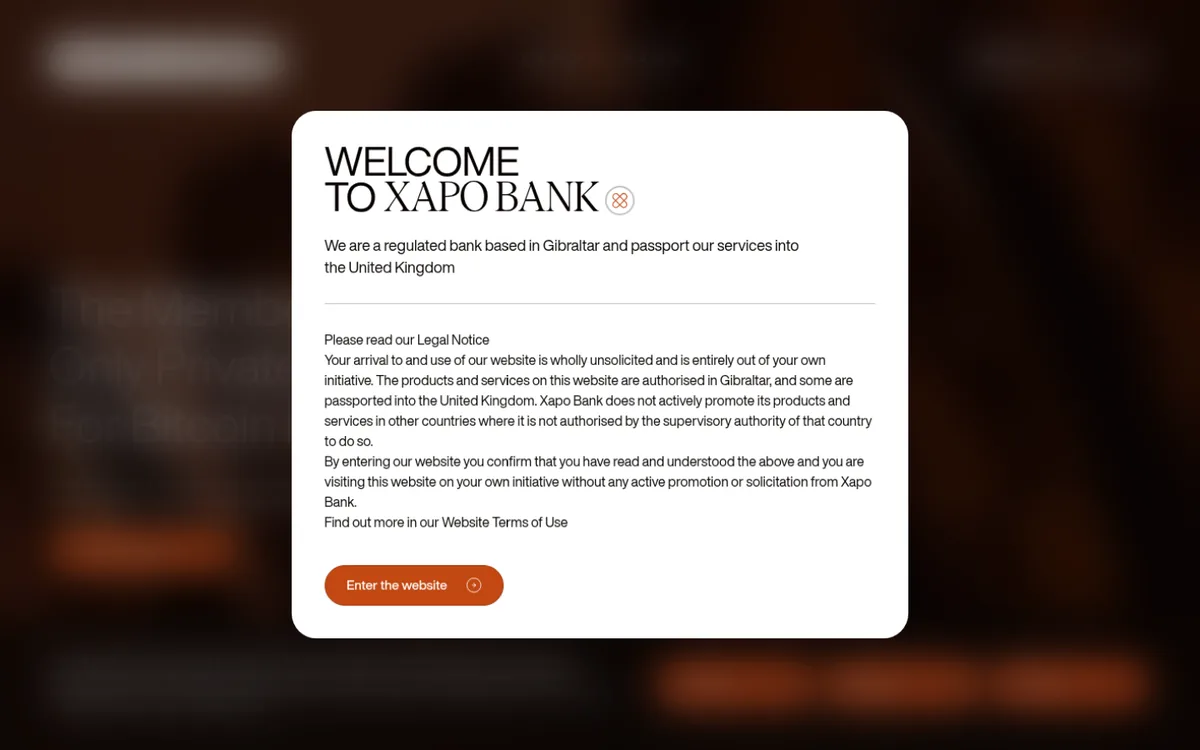
Xapo Bank membership page, live capture - the full-price version of global coverage: $1,000/year, published ATM limits, no-FX worldwide spending.
The travel playbook
For cross-border use, the sequence that avoids every documented failure: verify your country on the program's exclusion list [3][4]; verify the funding coin's status in your jurisdiction; test a small transaction at a foreign terminal before relying on the card; decline DCC every time [see the zero-FX hub]; and carry a backup card from a different program and BIN - the single-BIN failure mode (network suspension, sponsor exit) is the one risk no program mitigates for you. The physical hub covers the ATM side of travel; this page covers the geographic side.
The backup-card rule deserves its emphasis because it is the only mitigation that works against all four layers at once. Programs share BIN sponsors more than their branding suggests, so "different program" is not enough - the hedge that works is a different issuer, ideally in a different jurisdiction, funded through a different rail. A second card from the same sponsor is one card with extra steps.
Reading the ranking
47% of the fee data here is independently verified - the region claims are mostly operator-reported, which is precisely why the exclusion lists matter more. The ranking scores whole cards; the region column above is live from our database with check dates on each card page. Global-claim skeptics: start with the programs that publish their exclusion lists [3][4] - publication is itself a signal of how the program treats its users. Corridor-specific users: the US hub, Europe hub and the coin-specific pages cover the regional markets where the constraints are documented rather than marketed. And for the genuinely borderless use case, the no-KYC hub is the fastest-onboarding corner of this set - with its own honest list of what that speed costs.
The closing frame for every GLOBAL badge you will ever read: reach is a sponsor's promise about a BIN and a compliance posture, both of which change without your involvement. The card you can actually use is the one whose exclusion list you have read, whose funding coin works in your jurisdiction, and whose sponsor survived the last two years of this market's consolidation. Everything else is the landing page.
Almost always "available worldwide, subject to restrictions" - and the restrictions do the work. Documented exclusion lists on global-branded programs run to 40-50 countries: Goblin's features page lists ~50 restricted countries including Russia, Belarus and China [3]; Plasbit's published list includes Russia, Belarus, Iran, North Korea, Cuba, Syria - and the US and UK [4]. The badge is marketing; the list is the contract. Read it before ordering, not at first decline.
Why is the issuing country, not my location, what matters?
Network access keys off the BIN - the digits identifying the issuing bank and country. When Visa suspended Russia operations in 2022, the official language was about cards ISSUED in Russia [1][2]: domestic cards stopped working abroad and foreign cards stopped working inside. The same geometry powers every regional block, which is why a card's country of issuance - not your residency - is the first thing a network suspension touches.
Can a "global" card stop working in my country later?
Yes, through four mechanisms: network-level suspensions (Russia 2022 [1]), issuer-level country list changes, FATF-blacklist enforcement at the terminal (ether.fi documents North Korea, Iran and Myanmar blocked at ATMs), and funding-coin compliance changes - the MiCA delistings showed EEA arms dropping non-registered stablecoins wholesale. None requires your consent; all appear in terms you agreed to at signup.
How do I check my country before ordering?
Two primary sources in order: the program's own restricted-countries or availability page (Goblin and Plasbit publish theirs [3][4]), and the funding coin's status where you live - our region checker maps the tracked set, and the Europe hub covers the EMT layer that decides whether your funding coin still works in the EEA. Residency rules bind at KYC; a mismatch surfaces at onboarding, not at checkout.
Are excluded-country lists permanent?
No - they move with sanctions and compliance posture. Programs add and remove countries as regulations shift, and the lists are explicitly changeable in the terms. The practical defense: verify the list at order time, keep balances sized to migration, and expect the list to be longer, not shorter, over a card's life.
What is the difference between geo-blocking and MCC blocking?
Geo-blocking refuses transactions by location or BIN country; MCC blocking refuses them by merchant category - gambling, crypto purchases, money transfers and weapons appear on published blocked lists [3]. A card can be perfectly usable in your country and still decline the specific purchase you want. Both layers live in the same terms document; the virtual hub covers the MCC side in detail.
Do global cards work for travel, honestly?
Yes, with the DCC discipline from the zero-FX analysis and the ATM cap from the physical hub - the exclusion-list check at order time is what makes travel use real. The failure pattern is specific: cards that work at home then decline abroad because the merchant's acquirer flags the BIN country, not because of anything you did. A backup card from a different program is the standard mitigation.
Which programs are genuinely broadest?
Measured by what is published: Goblin ships globally with a ~50-country restriction list and both virtual and plastic [3]; Xapo's membership model prices worldwide coverage at $1,000/year with a $2,000/day ATM limit; RedotPay has claimed 180+ countries in affiliate terms (January 2025 archive - verify against live terms). The honest metric is not the marketing number but the exclusion list - shorter is not better or worse, just different exposure. Programs that publish their lists [3][4] are easier to trust than programs whose reach is only ever claimed in marketing copy.
What happened to genuinely global programs?
They consolidated. Binance Card left the EEA in December 2023 (its 2026 relaunch is Latin-America-only); the Kulipa issuer collapse took ~120,000 cards offline in July 2026 [see the virtual hub]; EEA stablecoin delistings narrowed funding corridors. The 2026 market is regionalized by compliance - the "global" programs that remain are the ones whose BIN sponsors and funding coins survived. That is context for interpreting any single program's claim: reach is expensive to maintain, and programs that keep it usually charge for it (Xapo's subscription model).
How do sanctions affect me as a card user?
Indirectly but concretely: issuers screen against sanctions lists at KYC and sometimes at transaction level, FATF-blacklist countries are blocked at terminals regardless of program promises, and funding chains that touched sanctioned addresses can freeze on-chain before reaching the card. Compliance applies to the user regardless of the program's KYC level - the no-KYC hub documents what skipping the paperwork does and does not change. The practical layer for ordinary users: keep the funding chain clean (regulated acquisition, no mixing services), because a frozen on-chain deposit is the one geography problem no region list warns about.