Cards that spend directly from wallets you control - no custodial balance, no counterparty holding your coins.
Short answer:ether.fi Cash is our top-rated self-custody card as of 2026-11-07 (7.6/10), Basic KYC, 0% load fee.
cards on this page: 11 · issuing today (excl. watch list): 7 · independently verified facts: 82% · no KYC at first use: 0%
quick picks
the full collateral architecture with published liquidation math→ether.fi Cash - USDC/EURC/USDT at 90% LTV, 95% liquidation threshold, borrow via Aave v4 - the most documented self-custody design
MetaMask-native spending→MetaMask Card - Mastercard + Baanx consortium, mUSD issued through Bridge, 3% at Metal tier - but US signups paused since June 2026
The most complete self-custodial spending stack in this comparison: your own vault plus real bank rails in four currencies (ACH, SEPA, GBP FPS, Swiss IBAN), 3% ETHFI cashback on the first $2,000/mo with Category and 5% travel boosts, KYC light in practice (ID + liveness; proof of address only on request - verified first-hand September 2026 with a Paraguayan cedula and a German passport) and an uncapped public affiliate program. The documented risks are real: interest from the first tap in Borrow Mode, liquidation risk, the November 2025 fraudulent-card incident with promised refunds, a protection program still marked not yet live that excludes compromised keys, and cashback now locked in volatile ETHFI instead of instant USDC.
Watch for the December 2026 sunset: the consumer product is closing. Solid self-custody architecture (card only moves whitelisted tokens from your Safe to settlement, up to a daily limit), but as a spending card it has an end date. Migrate to a partner app (Rebind/Picnic) or another self-custody card before 20 December 2026.
Full KYCphysical cardself-custody0% FXclosing 2026-12-20
The most mainstream self-custody card: MetaMask wallet spending stablecoins on Linea through a Mastercard program run with Baanx/Monavate, keys stay yours. 1% mUSD cashback on the orderable Virtual card; US and UK sign-ups are paused, Metal (3% tier) paused since June 2026. Verify current availability in-app before ordering.
A credible, well-backed self-custodial spend card with genuinely low fixed costs ($0 monthly/issuance/shipping, 0% APR) and true on-chain collateral custody in smart contracts. But it is not a privacy product (full KYC with SSN/national ID, GLBA data sharing), the rewards program is opaque (earn rates only in-app, statement-credit redemption at 70% of face), international FX is 'up to 3%' with a 1%-vs-2% disclosure conflict on the US side, and spending limits can be cut at Rain's sole discretion - with liquidation possible 'without prior notice'. Best for AVAX/stablecoin holders in the US (partial) and Latin America/Caribbean who want to spend against their stack; not for no-KYC users, and international terms (1-day payment window) behave much harsher than the US 21-day credit cycle.
The Nuri relaunch is a self-custodial wallet (Euros, Dollars, Stablecoins, Bitcoin) with a free Visa card on Wirex BaaS infrastructure - operator verifiable (Nurisoft Development OÜ, Tallinn), card wallet self-custody, GBP 30,000 limits. But no official statement connects it to the insolvent 2022 Nuri GmbH, and the fee schedule hides in the Wirex layer. Verify card terms before loading.
Bleap is one of the few crypto cards whose core fee promises check out: free issuance, no monthly fee, Mastercard rate with no FX markup, and free ATM withdrawals up to 400 EUR/month, all debited from a genuinely non-custodial MPC wallet with a named Cypriot EMI issuer and a verifiable MiCA CASP license. The catch is that the famous 'up to 20% cashback' is a lattice of category promos with small eligible-spend caps (realistic value is roughly 1% on everyday spend up to 3,000 EUR/month), the 2% groceries and dining rate already expired in May 2026, rates can change without notice, and the physical card is referral-only. Availability is EEA plus Switzerland only, with 45 excluded nationalities and some EEA countries still on a waiting list.
The most aggressive yield+cashback package in the crypto-card market, from the USDe team itself: virtual Visa with 4-5% cashback and up to 6% p.a. on balances, near-zero fee stack (no FX markup, no monthly, free issuance), self-custodial wallet, live in 48 countries across LatAm/Caribbean/Asia-ME/Africa/Oceania. The catch: rewards are paid in AVAX, are explicitly discretionary and tier-gated (Pro/VIP via limited referral-based spots), spending limits are opaque and collateral-driven, and the card is secured - your own collateral can be liquidated if a charge goes unpaid past one day or your collateral value drops. Only weeks old; no track record of its own. Strong spend-card pick where available; treat the yield as promotional, not contractual.
Tuyo Card is a genuinely self-custodial USDC-on-Base spending card with unusually good raw specs: no issuance/monthly/yearly fee, 0% on USD-in-US spend, huge daily limits ($50k rising to $200k), broad country availability outside a well-published 27-country prohibited list, and a detailed, dated help center - rare transparency for availability. The weak points are real: there is no cashback (BNPM random free purchases are a marketing lottery, not a reward rate), TUYOs points are unvalued until a promised 2026 token, and there is a material fee-truthfulness gap - the binding cardholder agreement allows up to 3% FX + 3% cross-border, double the 2% ceiling the site advertises. Full KYC (SSN/DOB via issuer Third National) and an individual-arbitration class waiver sit alongside the self-custody pitch. Virtual-only (physical 'coming soon'), ATM capped at $250/withdrawal and 3 attempts/24h. A good self-custody spending rail for USD-centric users who live outside the excluded jurisdictions - but treat the 'fees' as '1-2% advertised, up to 3-6% legally possible' and the rewards as lottery tickets, not yield.
Hyperbeat Pay is the card of the Hyperliquid ecosystem's yield layer: a Visa credit/debit hybrid where a self-custodial smart wallet (ManagementAccount) settles spend from your beatUSD/USDC balance or JIT-borrows beatUSD against BTC/ETH/SOL/HYPE collateral in dedicated Morpho markets - spend without selling, audited by Zellic/Nethermind, issued by Third National under Visa. The mechanics are genuinely novel (on-chain settlement, user-set operator allowances, timelocked withdrawals) and self-custody is real. The weaknesses are transparency and reachability: no public fee schedule or cardholder agreement (fees only via DefiLlama), cashback token (WHYPE) not documented, a template artifact from ether.fi in the legal terms, an operator entity with no published incorporation, and a cashback model whose headline 3-12% tiers demand $1M-50M monthly trading volume - the realistic everyday rate is 0.2-1.0%. Strong for active Hyperliquid traders; ordinary spenders get a thin-rewards card with undocumented fees.
The most token-aligned card on the market: Plasma One is a real, working stablecoin neobank (instant virtual Visa, self-custodial on-chain balance, broad fiat rails, transparent fee tables, genuinely strong headline cashback) built by the XPL blockchain team - and every part of its economics points back at the token. Cashback is paid in XPL, the paid tiers are bought with 12-month XPL locks, and growth is driven by referral codes rather than organic demand. The free Lite tier is honest value (2% on the first $500/mo, free virtual card) if you treat the XPL payout as a hot potato, but the Core/Platinum tiers ask you to lock a token that has lost ~95% from its ATH for 12 months to unlock rates that then step down to 0.25-1% anyway. Use Lite, cash out weekly, and skip the locks unless you would buy XPL anyway.
Genuinely novel onchain-credit card: your deposits sit in the audited Exactly fixed/variable-rate lending markets earning variable yield while acting as collateral; Pay Now debits your balance, Pay Later borrows fixed-rate on-chain and repays in up to 9 installments every 28 days - all at 0% APR with the cost embedded in the fixed borrow rate (optional origination fee). Self-custodial smart-account wallet (passkeys), free virtual Visa Signature, instant issuance, Apple/Google Pay. Weak spots: no purchase cashback (only capped promo campaigns), 1.5% FX + up to 1.5% cross-border on the international card, virtual-only, full KYC, issuance concentrated in LatAm/Africa/Asia + 31 US states (not Western Europe/UK/Canada), and protocol exploit history means collateral is exposed to smart-contract risk by design.
11 live programs let the card spend without the issuer holding your balance - 100% of this page's population by definition. The niche split cleanly into two designs, and the design choice matters more than any fee difference on this page: the collateral model borrows against your vault; the settlement model moves your tokens per transaction. Both exist because the same trade appeals from different directions - holders who want spending against their portfolio, and users who want no float anywhere at all.
The two self-custody architectures against the custodial contrast.
The collateral model, with the published numbers
ether.fi's Cash card is the fully documented implementation: stablecoin collateral (USDC, EURC, USDT, frxUSD) at 90% LTV with a 95% liquidation threshold and 1% liquidation bonus, ETH-family at 55%, BTC-family at 52% [2]. Two modes: Direct Pay spends USDC/LiquidUSD from the vault with no interest; Borrow Mode borrows against the whole vault with interest accruing immediately at a variable APY through Aave v4 markets [1]. Card contracts live on Optimism; deposits are accepted on 14+ networks without KYC, with verification happening before first card use [3].
The honest risk ledger: liquidation is not hypothetical at 90% LTV - a depeg day on the collateral plus a spending balance can reach the threshold, and the Debt Manager liquidates 50% first [2]. The mitigation is boring: spend-mode users keep the vault in the same stablecoins they spend; borrowers size to the 95% threshold with the interest accrual in mind. 82% of the programs here have independently verified fee data; the rest are operator-reported, and ether.fi's documentation is the most complete in the niche - which is why its numbers anchor this section.
Live values from our database - details and caveats in each review. "-" = not published by the operator.
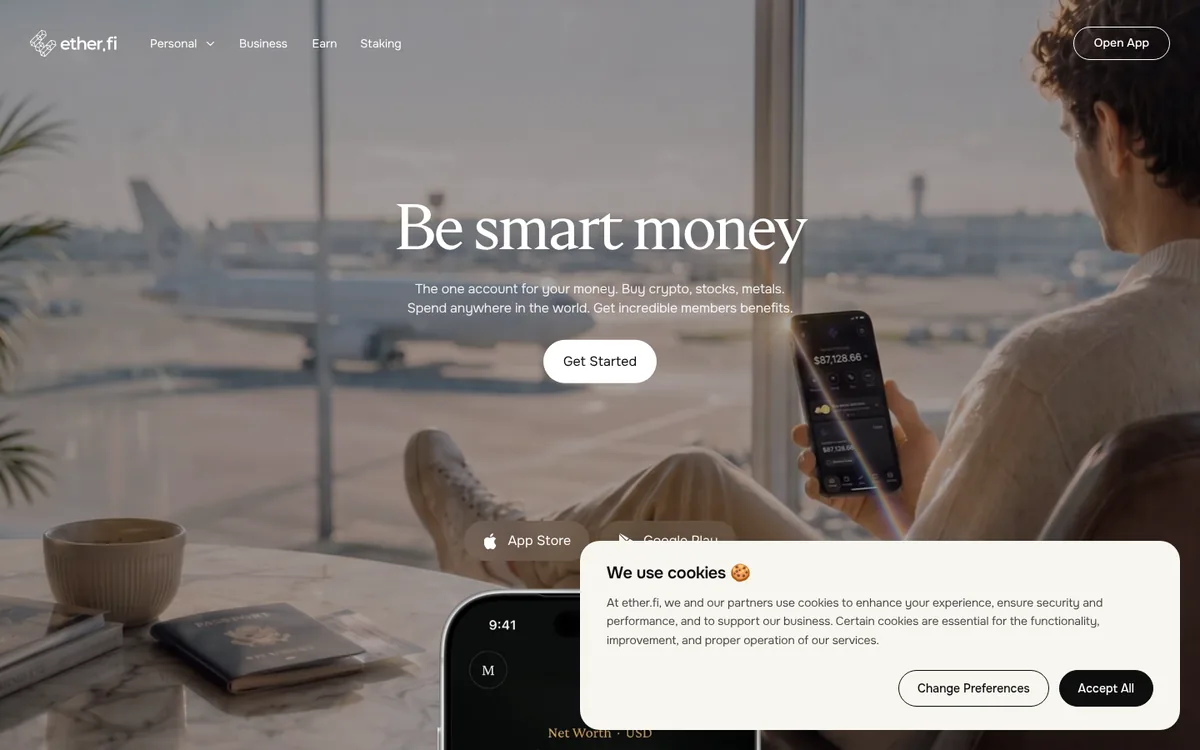
ether.fi Cash, live capture - the fully documented collateral architecture: LTV table, modes and supported networks all public.
The settlement model, and its 2026 lesson
Gnosis Pay's design remains the reference: your Safe holds the balance, the roles module lets the operator move only whitelisted tokens, only to the settlement address, only up to a daily limit - the issuer never holds anything. The 2026 lesson cuts both ways: the program is winding down consumer operations on 20 December 2026 [5], and even perfect custody architecture does not preserve a card product whose economics changed. Your coins were never at risk; your card was. The successors (Rebind, Picnic/MiniPay) inherit the model - the Europe hub tracks the licensing layer beneath them.
MetaMask Card runs a hybrid: your wallet balance funds spending across four chains, with the Mastercard/Baanx consortium and Bridge-issued mUSD as the named infrastructure [4]. It is the most consumer-polished of the set - and its US pause (since 3 June 2026) is the reminder that consortium cards inherit consortium constraints. Holyheld, once part of this set's architecture conversation, pivoted to a Swiss membership-payments platform whose current site documents neither smart-account custody nor an issuer - a reminder that architecture claims need annual re-verification, not one-time trust. Coca's "non-custodial" claim is in the same category: public documents name no issuer at all.
What the July 2026 Kulipa collapse proved
The failure that custodial card users fear most - the program dies and balances freeze - killed roughly 120,000 crypto cards overnight when issuer Kulipa wound down, taking ready-branded and Solflare cards with it [8]. The self-custody reading is not "immune" but "different": users whose coins sat in their own vaults or Safes kept their assets; what they lost was the card. That is the precise advantage of this niche - not immunity from failure, but the difference between losing access and losing money.
It is also the honest limit of the advantage. A vault or Safe survives the issuer; the card relationship does not - a wind-down still ends your spending rails, still requires migration, and still leaves you reading operator notices about withdrawal windows. The difference is that your money never becomes part of the negotiation. When you size balances for this niche, size them for the migration scenario: how much would you want to move to a new program within a week? The frozen balances guide documents the custodial version of the same event, where the answer is measured in payout queues rather than migrations.
Choosing from the ranking
11 programs define this page, and the ranking scores whole cards; use the architecture as the first filter - it is the only choice on this page that cannot be changed after a balance exists. Holders wanting liquidity without selling: the collateral model, with the LTV table read first [2]. Minimal-float purists: settlement-model designs, accepting the per-tap conversion. Stablecoin income that should stay stablecoin: both architectures work, and the stablecoin hub covers the coin-level choice - convert-at-load versus hold-until-tap is the same question this page answers at the architecture level. 8 of 11 programs charge no monthly fee, and 82% support wallet provisioning - but the real shortlist question is architectural: whose risk do you want to hold, the market's or the issuer's? The credit hub covers the borrow-against-collateral route in its regulated credit-line form, which is the custodial-issuer answer to the same portfolio question.
The issuer never holds your balance. In the collateral model (ether.fi), your coins sit in your own vault and the card borrows against them at up to 90% LTV for stablecoins; in the settlement model (Gnosis Pay), whitelisted tokens move from your smart-account Safe to the settlement address per transaction, under a daily limit. In both, a card-program insolvency cannot freeze funds it never held - the documented failure mode of custodial card programs.
What risk replaces issuer insolvency?
Price and liquidation risk. A self-custody balance wears the coin's mark until settlement - the 2023 USDC depeg to $0.882 would have hit a Safe balance directly - and the collateral model adds liquidation math: at ether.fi, stablecoins liquidate above 95% LTV with a 1% bonus to the liquidator, and borrow interest accrues from the first transaction with no grace period [1][2]. Sizing to a clearance-window delay, not to maximum, is the discipline that keeps both risks theoretical.
Borrow Mode or Direct Pay - which should I run?
They optimize different behaviors. Direct Pay spends USDC (primary) and LiquidUSD (fallback) straight from the vault with no interest - the clean path for someone who deposits stablecoins to spend. Borrow Mode keeps every vault asset in place as collateral and accrues interest immediately at a variable APY set by the lending market (Aave v4) - the path for holders who want liquidity without selling [1]. Refunds do not reduce a borrow balance automatically in Borrow Mode - worth knowing before a large refundable purchase.
What collateral is allowed, and at what LTV?
The published table: USDC, EURC, USDT and frxUSD at 90% LTV (liquidation threshold 95%, 1% liquidation bonus); liquidUSD-class assets at 80%; ETH-family at 55% (threshold 75%); BTC-family at 52%; small-caps like OP and ETHFI at 20% [2]. The stablecoin tier is the card-relevant one - spending against ETH collateral is possible but liquidates fast in a drawdown. Liquidation runs through the Debt Manager: first 50% of collateral, then the rest.
Is MetaMask Card really self-custody?
Yes, with named infrastructure: the card works with Mastercard and Baanx, spending draws on your own wallet balance across Linea, Base, Monad and Solana, and the mUSD spend asset is issued through Bridge (a Stripe company) backed 1:1 by USD and short-term Treasuries in regulated custody [4]. The caveat is operational: US sign-ups have been paused since 3 June 2026, and the Metal tier (3% back) carries the card's conditions. Verify your region's onboarding state in-app before planning around it.
What happened to Gnosis Pay, the reference design?
The consumer card and web app stop on 20 December 2026 (formal notice 2026-09-21) as the company pivots to B2B; balances migrate to partner apps (Rebind for EUR, Picnic/MiniPay for USD) [5]. The architecture - roles module, daily limit, whitelist - remains the reference for the settlement model, and the successors inherit parts of it. If you hold a Gnosis Pay balance, treat the date as a migration deadline, not a suggestion.
What happened to Solflare's card?
It suspended services in late July 2026 after its issuer, Kulipa, wound down - roughly 120,000 crypto cards across programs went offline overnight; Solflare's card page now resolves to a glossary article with no product [8]. The case is the cleanest recent illustration of why the issuing layer, not the wallet layer, decides a card's survival - see the virtual cards hub for the BIN-sponsor mechanics.
How do I load a self-custody card?
Into your own address first. ether.fi accepts USDC on 14+ networks (Ethereum, OP Mainnet, Arbitrum, Base, Solana and more; USDT additionally on Tron/Kaia/Plasma) without KYC - KYC happens before card use, not before deposit [3]. Settlement-model cards load to your Safe. The practical consequence: deposits are reversible by no one, so first loads follow the minimum-amount discipline - the first-load rules apply doubly when no custodian can rescue a misdirected send.
Are fees higher on self-custody cards?
The visible card fees are competitive - ether.fi's FX base is ~1% plus tier surcharge (Core 0-0.5%, top tiers 0) with $1,000/transaction ATM limits [3] - and 8 of the 11 programs here charge no monthly fee at all. The invisible fee is the carry: collateral interest on borrowed spending (variable, market-set), and the optionality you give up by keeping coins in place. Price the routine end to end in the fee calculator before assuming the headline FX number is the cost.
Where are self-custody cards actually available?
ether.fi's card covers ~85 countries including most US states (NY, CA, TX, FL among them), with Belgium and Ireland eligible but physical-card-excluded; MetaMask covers EEA/UK regions with US paused; the settlement-model programs are EEA-centric [3][4]. 4 of the programs here list EEA availability - the region column in the table is live, and residency rules bind at KYC, not at the border.
Which failure modes should I actually prepare for?
In order of likelihood: a chain-level deposit mistake (no custodian to rescue it), a liquidation event in the collateral model (depeg plus leverage), and program wind-downs - which self-custody softens (your coins are yours) but does not eliminate (the card relationship still ends; Gnosis Pay 2026). The frozen balances guide covers the custodial versions of these failures for contrast.