The rare segment: cards that accept Monero directly - privacy coins usually stop at the exchange door.
Short answer:Freedomia is our top-rated Monero debit card as of 2026-11-07 (7.2/10), No KYC, 1.3% load fee.
cards on this page: 3 · issuing today (excl. watch list): 3 · independently verified facts: 0% · no KYC at first use: 100%
quick picks
the cheapest documented XMR funding path→Freedomia - 1.3% load fee with XMR native plus Lightning and eight fallback chains - the lowest total cost to move Monero into spending
XMR funding with zero fixed costs→Goblin Card - $0 monthly and 0% listed FX; the cost concentrates in the 3.5% (4% XMR) load fee, documented with the swap-layer reason
The most complete no-KYC crypto card we track: instant virtual Visa, Lightning Address top-ups, Tor support, working ATM withdrawals via Google Wallet NFC, responsive multilingual support and a year of positive user reports with no documented incidents. The fee stack is honest and the 1.3% load is the cheapest in the no-KYC niche. Counterparty risk stays material - the issuer is undisclosed, the operator is a self-declared Delaware LLC at a registered-agent address, balances are custodial with no way back on-chain, and even a chargeback demands KYC and $250. Treat it as a spending pipe: top up, spend, replace.
best no-KYC pickNo KYCLightningXMR direct
1.3% load · 2.5% FX · no cashback
$5,000 (Founder/HODL); $10,000 (MOON, announced)★★★★☆4 (1)Crypto-native 40 h ago
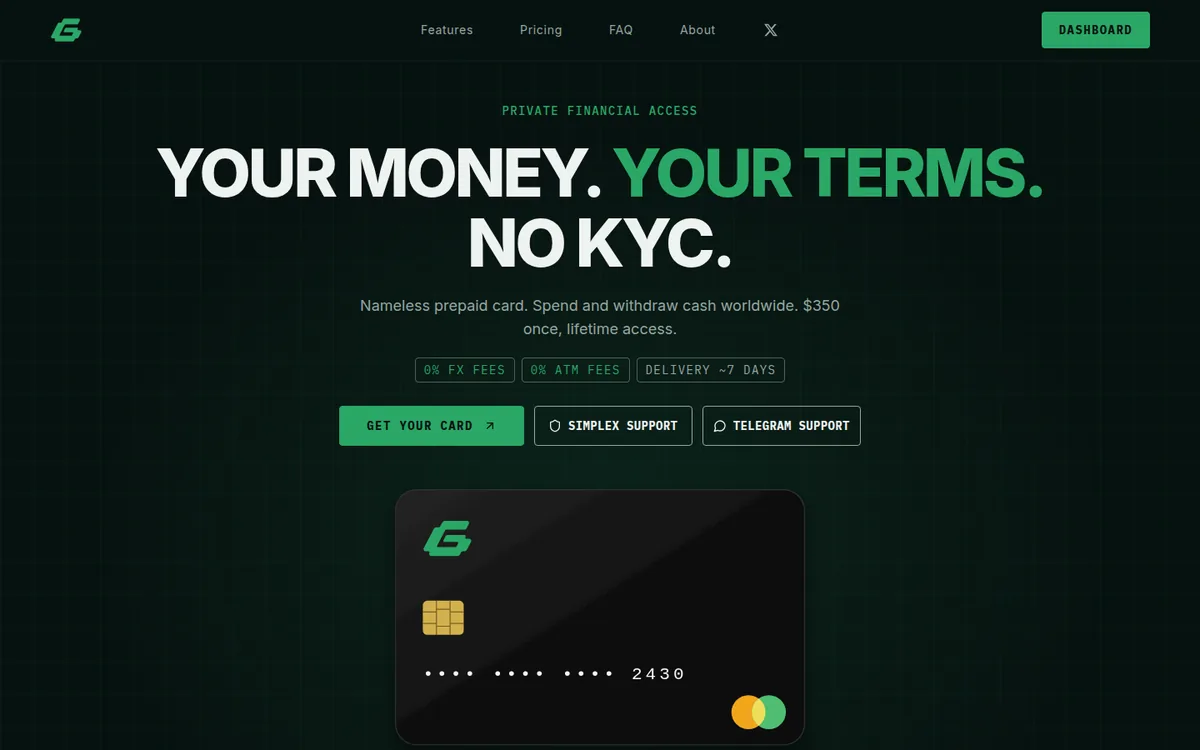
The strongest physical no-KYC card pitch: a real Mastercard with ATM access, 0% FX and 0% ATM fees, XMR deposits and privacy-preserving support channels. The trade-offs are a $350 entry price, 3.5-4% deposit fees and an unlicensed custodial balance - treat it as a privacy tool, not a bank account.
A Monero-capable virtual Mastercard with Apple/Google Pay support and $10-$10,000 loads - a rare direct-XMR card. Until fees, limits and the operator behind it are verifiable, treat it as an unverified lead: fund only what you can afford to lose.
3 programs take Monero natively, every one in the no-KYC corner of this market, and the architecture is the same behind all of them: XMR arrives on a chain where amounts and counterparties are invisible, a swap layer converts it to a spendable equivalent, and the card spends ordinary fiat at ordinary terminals. The product is the seam between those layers - and the fee table prices the seam: Goblin documents 4% on XMR deposits against 3.5% on other coins, "due to DEX fees" [3]. That half-percent is what the privacy rail costs at the swap, on top of everything else. It is also the most honest line in the niche: a documented fee for a documented service, in a market segment where most pricing is marketing.
The Monero funding chain, with the swap premium where it actually sits.Goblin Cards, live capture - the 4% XMR deposit fee and its "DEX fees" reason are documented in the FAQ, not buried in terms.
The funding math, layer by layer
Three costs stack on an XMR load, and they are worth separating. The rail: Monero transfers measured $0.02-0.14 across 367 recent transactions [1] - flat, cheap, unrelated to load size. The swap: ~0.5% where documented [3], plus the swap's spread on XMR price at the moment of conversion. The program's load fee: 1.3-6.5% across this page's set - the widest spread in our market, and the reason the fee calculator exists. On a $200 load at the cheapest stack, the total overhead is roughly $3-4; at the most expensive, roughly $15. The privacy premium is real, quantifiable, and paid per load.
The confirm-time layer is the one nobody prices until they experience it: ~20 minutes for Monero confirmations [1], plus swap settlement, plus the card's own crediting. 1 of the programs here offer Lightning as the fast alternative - funding in BTC-LN over XMR when speed matters, XMR when it does not. The two rails also answer different questions: Lightning is fast but public (the network sees channel flows), XMR is slow but private (the chain sees nothing) - and the choice between them is a threat-model question that no fee table answers.
Live values from our database - details and caveats in each review. "-" = not published by the operator.
The regulatory direction, honestly stated
The confirm-time layer is the one nobody prices until they experience it: ~20 minutes for Monero confirmations [1], plus swap settlement, plus the card's own crediting. 1 of the programs here offer Lightning as the fast alternative - funding in BTC-LN over XMR when speed matters, XMR when it does not. The two rails also answer different questions: Lightning is fast but public (the network sees channel flows), XMR is slow but private (the chain sees nothing) - and the choice between them is a threat-model question that no fee table answers.
The trend is one-way and worth naming: Binance delisted XMR in February 2024 [6], Kraken delisted it in Ireland and Belgium the same April, and the EU's AML package targets privacy coins and anonymous accounts by 2027. The no-KYC card niche exists partly as a workaround for exactly this consolidation - and its 100% share of this page is the workaround's entire visible supply. What that means practically: the swap layer these programs run is the load-bearing compliance surface, and its terms are the ones to re-read when delisting news lands. The funding rail (XMR itself) remains legal to hold and transfer in most jurisdictions; the ramps are what narrow [6].
Warning: The custody reality behind the privacy claim: once the swap completes and the card loads, the balance is custodial and subject to every freeze and wind-down dynamic documented elsewhere on this site. The private rail protects the funding chain's history - it does not protect the balance, and it does not change what a dying program does with it. Load small, spend fast, and the risks guide is the playbook.
What privacy this product actually buys
The layered answer, because the layers are sold conflated: onboarding privacy (no identity document at the issuer - what this page sells), funding privacy (chain-level, real, what Monero delivers), and transaction privacy at the terminal (which no card delivers - the network sees every purchase). 0% of this page's population is self-custody, which moves the balance-side risk too. For users whose threat model starts at "no ID photo on file," this niche is the product. For users whose threat model ends at transaction-level privacy, the card is the leak - and the honest alternatives are spending architectures, not onboarding flows: the self-custody hub and the spend-monero guide.
The middle layer deserves its own sentence because it is where most confusion happens: funding privacy is perishable by design. The swap breaks the link between your XMR and the card balance at swap time - but every subsequent action that ties the balance back to an identity (a delivery address on plastic, a chargeback dispute, a KYC trigger) re-links the chain retroactively. Privacy in this niche is a usage discipline, not a property of the card: the programs that survive user scrutiny [5] are the ones whose users behave as if the swap layer keeps logs, because it probably does.
Reading the ranking
The final frame for the niche: it is small, expensive per load, and honest about why - a rare combination in crypto spending. 3 programs, 100% onboarding without full KYC, 2 at $0 monthly, median load fee ~2.4% - the highest in our whole comparison set, and the price of the compliance posture the rest of the market abandoned. The ranking scores whole cards; the XMR-specific decision is the fee stack at your load size, which is arithmetic, not opinion. Community signal [5] remains the best freeze-risk intelligence in this niche - the terms pages move last.
A clean fiat card at the terminal and a private rail behind it. The merchant, the network and the BIN see ordinary card transactions; the funding chain (XMR in, swap to USDT or fiat, card load) carries no visible link to your identity beyond what the program itself records. The product is onboarding and funding privacy - not transaction privacy at the terminal, which no card delivers.
What does the swap layer cost?
Documented directly by Goblin: 4% deposit fee on XMR versus 3.5% on BTC/ETH/SOL/USDT, attributed to "DEX fees" [3]. That ~0.5% is the swap premium on top of the program's load fee (1.3-4% across the live niche; the 6.5% figure belonged to 2Fiat, whose site has been unreachable since around 2026-10-10) and Monero's own network fee (~$0.02-0.14, measured across 367 recent transactions [1]). The stack is honest at these programs - the privacy costs what it costs, on a line item.
How fast does an XMR load credit?
Monero confirms in roughly 20 minutes (2 confirmations at ~10-minute blocks), then the swap layer adds its own settlement. Total load-to-spendable is typically 20-40 minutes - slower than a SEPA top-up, faster than waiting for exchange KYC queues. Freedomia's Lightning rail exists precisely for the impatient half of this loop [4]. Plan loads ahead of need: the one thing this rail does not do is last-minute.
Is Monero still usable after the delistings?
The funding side works - the no-KYC card programs in this set accept XMR directly via their swap layer [3][4]. The exchange side is where the pressure shows: Binance delisted XMR in February 2024, Kraken delisted it in Ireland and Belgium, and the EU's AML package targets privacy coins by 2027 [6, ESMA context at 8]. Holding and transferring XMR remains legal in most jurisdictions; the on-ramps and off-ramps are narrowing, which is exactly what this card niche monetizes.
What records does a no-KYC card create?
Whatever its onboarding asks (email, delivery address for plastic), the BIN/network records of every transaction, and the program's own logs. "No KYC" removes the identity document - not the records. Privacy threat models that need transaction-level unlinkability need the funding and spending layers both: XMR in, card out, and an awareness that the card's spending is pseudonymous at best [7].
Why is the deposit minimum higher for XMR?
Swap operations have fixed costs that only make sense above a floor - Goblin documents a $100 minimum deposit on the FAQ where the 4% XMR fee appears [3]. The economics: the swap layer's overhead is per-operation, so small XMR loads lose an unreasonable share to fixed costs. Fund in larger, less frequent loads, or route through the zero-FX verified set with a cheap on-ramp.
Is the privacy claim of these programs verifiable?
0% of this page's fee data is independently verified - the lowest in our comparison set - and the privacy claims are likewise operator statements. What you can verify yourself: the funding chain's on-chain privacy (Monero's cryptography), the program's public terms, and the community reports [5]. What you cannot: what the swap layer logs, what the issuer retains, or what happens to records at a wind-down. Size expectations accordingly.
What happens if a program with my XMR-funded balance dies?
The same freeze-and-queue process as any custodial card - the frozen balances guide covers the mechanics. The private rail does not change the custody reality: once swapped and loaded, the balance is the issuer's fiat. The July 2026 Kulipa collapse (which took programs serving anonymous users offline overnight) is the recent template [see the virtual hub].
Is Monero funding legal?
Holding and transferring XMR is legal in most jurisdictions, including after the exchange delistings - the delistings are business decisions, not prohibitions [6]. Your obligations are tax (disposals at load are taxable events in most systems) and sanctions compliance (on-chain screening applies regardless of the card's KYC level). We do not give legal advice; the EU's 2027 privacy-coin measures are the direction of travel to watch.
How does XMR funding compare to Lightning funding?
Different privacy layers at different points. XMR funding buys chain-level privacy at the funding rail (the swap breaks the link between coin and card); Lightning buys public-network obscurity at the payment layer (nothing lands on-chain at all). The Lightning hub covers the latter; the two combine in principle - XMR in, swap, Lightning top-ups - at the cost of stacking both layers' fees.
Which XMR program should I pick?
The ranking orders by card quality with the fee premium documented. The decision variables are the load fee (1.3-6.5%), the swap premium (~0.5% where documented [3]), the monthly fee (2 of 3 at $0), and the format (1 ship plastic). 3 of the 3 take XMR natively - it is the entire population by definition, so the fee calculator with your load cadence is the deciding tool. Add one non-fee variable: how long the program has survived - this corner of the market has a turnover rate, and age is signal.