Cards that accept native SOL top-up directly - the fastest rails in crypto meeting the card networks. USDC-on-Solana funding shows up in the stablecoin hub, not here.
Short answer:Freedomia is our top-rated Solana debit card as of 2026-11-07 (7.2/10), No KYC, 1.3% load fee.
cards on this page: 3 · issuing today (excl. watch list): 3 · independently verified facts: 33% · no KYC at first use: 67%
quick picks
the surviving Solana-native funding path→Freedomia - SOL native alongside BTC, ETH, XMR and Lightning - the multi-chain program that outlived the single-chain ones
SOL-family funding with $0 monthly→Goblin Card - SOL listed as supported with 3.5% load and no KYC - the no-friction alternative for small Solana holdings
diversify away from single-rail programs→Freedomia - nine-plus chains on one card - the architecture lesson of the Solflare exit, applied by the program that survived it
The most complete no-KYC crypto card we track: instant virtual Visa, Lightning Address top-ups, Tor support, working ATM withdrawals via Google Wallet NFC, responsive multilingual support and a year of positive user reports with no documented incidents. The fee stack is honest and the 1.3% load is the cheapest in the no-KYC niche. Counterparty risk stays material - the issuer is undisclosed, the operator is a self-declared Delaware LLC at a registered-agent address, balances are custodial with no way back on-chain, and even a chargeback demands KYC and $250. Treat it as a spending pipe: top up, spend, replace.
best no-KYC pickNo KYCLightningXMR direct
1.3% load · 2.5% FX · no cashback
$5,000 (Founder/HODL); $10,000 (MOON, announced)★★★★☆4 (1)Crypto-native 40 h ago
The strongest physical no-KYC card pitch: a real Mastercard with ATM access, 0% FX and 0% ATM fees, XMR deposits and privacy-preserving support channels. The trade-offs are a $350 entry price, 3.5-4% deposit fees and an unlicensed custodial balance - treat it as a privacy tool, not a bank account.
A documented, fully-priced stablecoin Visa program with named regulatory registrations - but unresolved mega-litigation changes the risk picture: Binance sued RedotPay and its founders for ~$472.8M in August 2026 over alleged user-asset diversion. Custodial balances, freeze powers, no named issuer. Treat as usable-but-contested; keep balances minimal and watch the litigation.
3 programs take SOL natively after the July 2026 Kulipa collapse removed the Solana-branded consumer card from the market - and that number is the page's finding, not a filter artifact. The Solana rail itself is excellent: 0.000005 SOL base fee per signature (~$0.0006 at current prices) [1], seconds of settlement, documented on the network's own docs. The product layer above it never consolidated: the programs that served Solana users ran on a single issuing stack, and the stack failed. This page is short because the market is short, and the honest version of this page is more useful than a padded one.
The Solana rail's economics - and the liveness caveat that prices it.
The rail numbers
The verifiable layer: base fee 0.000005 SOL per signature [1], settlement in seconds, mainnet operational with no unresolved incidents since February 2024 [3]. The caveat layer: September 2026 saw a routing error take 29% of stake offline - a degradation, not a halt, but the kind of event a card load queued at the wrong moment meets as a delay. For funding routines, both facts price into the same rule: Solana is a fast, cheap rail whose liveness history has one asterisk - and programs that offer fallback chains make the asterisk irrelevant.
Live values from our database - details and caveats in each review. "-" = not published by the operator.
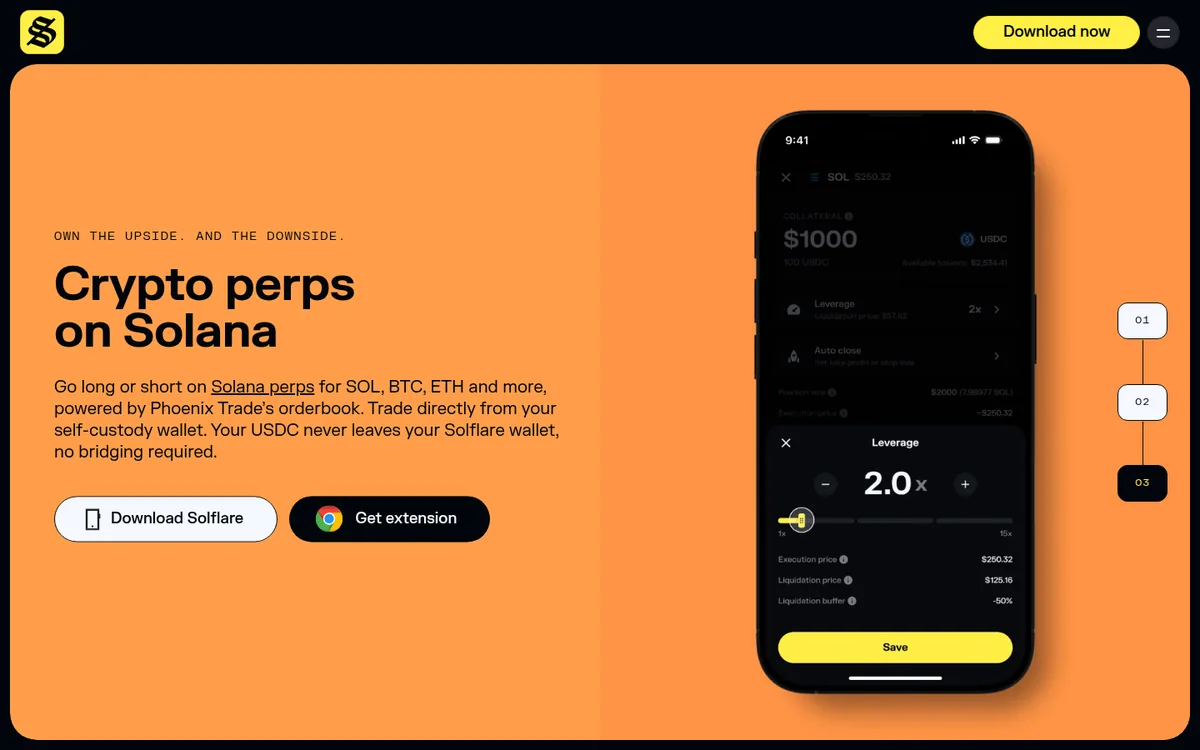
Solflare, live capture - the wallet's homepage after the card program ended; the /card page now resolves to a glossary article.
The Solflare post-mortem, briefly
The Solana consumer card died with its issuer: Kulipa's wind-down in late July 2026 took roughly 120,000 crypto cards offline across programs, and Solflare's card page now resolves to a glossary article [4]. The instructive detail is the concentration - the Solana ecosystem's consumer card layer ran on one sponsor, so one exit removed the category. That is the general BIN-sponsor risk [see the virtual hub] with a single-ecosystem amplifier: a program whose identity is one chain and whose issuer is one sponsor has two single points of failure.
33% of the fee data here is independently verified - the SOL network fees [1] are the solid part, the program terms are operator-reported. The community's post-mortem coverage [4] is the honest record of what the failure looked like from the user side.
Warning: The Solana case generalizes: any card program that is one chain deep is one sponsor exit away from this page's fate. The multi-chain programs (Freedomia's BTC/ETH/XMR/TRX/SOL stack [8]) survived the same event because no single failure removes them. Chain diversification in the deposit menu is not a feature list - it is the durability analysis.
What survives, and what it is good for
The thin product layer is the finding; the rail is not in question. The 3 surviving programs treat SOL as a rail, not a category - which is the correct architecture. For a Solana-heavy user, funding a card with SOL costs: the network's half-cent [1], the program's load fee (1.3-3.5% documented), and the conversion timing. 2 of 3 charge no monthly fee. 67% of the set onboards without full KYC. The fee calculator prices the routine; the bitcoin-lightning guide covers the alternative small-load rails.
Reading the ranking
The ranking is short because the population is - and its brevity is the page's finding. Solana-native spending without conversion: Freedomia's multi-chain stack is the durable route [8]. Small no-KYC loads: Goblin, with the SOL fee documented at 3.5% [6]. Solana-ecosystem users who want the wallet-native pattern: it does not exist on this rail yet - the ethereum hub documents what it looks like on the ETH family, and the gap here is the market's to close.
Technically, the best numbers on this site: 0.000005 SOL base fee per signature (~$0.0006 at $119 SOL [1]), seconds to settle. The catch is not the rail - it is the product layer above it. The Solana-native card ecosystem lost its flagship consumer program (Solflare) to the Kulipa issuer collapse in July 2026 [4], and the tracked set that takes SOL natively is 3 programs deep.
What happened to the Solflare Card?
Its issuer, Kulipa, wound down in late July 2026, taking roughly 120,000 crypto cards across programs offline overnight - Solflare suspended the card with a "new version coming" message that has not produced a product [4]. The /card page now redirects to a glossary article. The lesson is structural: a wallet-branded card is only as durable as its BIN sponsor, and single-rail programs die with their sponsors [see the virtual hub's BIN analysis].
What does Solana funding actually cost?
The network layer is the cheapest in crypto: 0.000005 SOL per signature [1], with optional prioritization fees - call it half a cent. The program layer adds the load fee (3.5% documented at Goblin for SOL [6], 1.3% at Freedomia's multi-chain stack) and whatever conversion the program applies. On a $100 load, the network fee is invisible; the program fee is the whole cost line.
How reliable is Solana for time-sensitive loads?
The liveness record has an asterisk worth knowing: the last full outage was February 2024 (status page shows zero unresolved incidents since [3]), but September 2026 saw a routing error take 29% of network stake offline - degraded, not halted. For card funding the practical reading: normal loads settle in seconds; during a degradation, a load waits like an on-chain confirmation. Programs with fallback chains (Freedomia's eight-plus alternatives [8]) price this correctly.
Does Solana Pay change the card picture?
It changes the merchant side, not the card side: Solana Pay integrates with Shopify for instant, near-zero-fee merchant settlement [3 - solanapay.com]. That is a competing rail to cards for Solana-native spending - a merchant can accept SOL directly without any card program in between. For funding a card, the network costs above are what matter; for Solana-native commerce, the card is optional.
What should a Solana holder actually do about spending?
Price the honest options. If SOL income needs spending, a multi-chain program that takes SOL natively (Freedomia, Goblin) converts it on the same rails as any other coin - no Solana-specific product required. If the goal is SOL-native spending without conversion, the product layer does not currently offer a durable option, which is the honest finding of this page. The bitcoin hub and stablecoin hub cover the rails with deeper program sets.
Why did the Solana card market fail while others survived?
Concentration. The Solana consumer programs ran on one issuing stack (Kulipa), so one sponsor failure removed the category [4]. Compare the stablecoin or bitcoin sets, where programs run on multiple BIN sponsors - the virtual hub documents the BIN risk generally. The surviving Solana-capable programs are the multi-chain ones (Freedomia, Goblin) for which SOL is one rail among several, not the business.
Is the Solana rail itself worth using where supported?
Yes, mechanically: sub-cent fees, second settlement, no confirmation planning. The Sept-2026 stake-offline incident is the reminder that the rail's liveness is not consensus-grade assured - a load queued during a degradation waits. 33% of the fee data here is independently verified; the SOL-specific claims (network fees [1]) are the verifiable part, the program terms are operator-reported.
Should I hold a SOL balance on a card program?
Follow the balance rules from every other page, with one addition: a SOL balance on a single-rail program inherits both issuer risk and chain-liveness risk at once. The multi-chain programs let you keep fallback rails warm (16 chains across this population). The frozen balances guide covers the custody side; this page adds the liveness layer.
What would make this category real again?
An issuer-level commitment - a BIN sponsor running Solana-native programs as a product line rather than a wallet's side project, with the withdrawal and migration paths in writing. The Kulipa collapse is the case study in what happens without that infrastructure [4]. Until a durable sponsor serves the rail, the honest products are the multi-chain ones above, where SOL is one rail among several.