The most complete no-KYC crypto card we track: instant virtual Visa, Lightning Address top-ups, Tor support, working ATM withdrawals via Google Wallet NFC, responsive multilingual support and a year of positive user reports with no documented incidents. The fee stack is honest and the 1.3% load is the cheapest in the no-KYC niche. Counterparty risk stays material - the issuer is undisclosed, the operator is a self-declared Delaware LLC at a registered-agent address, balances are custodial with no way back on-chain, and even a chargeback demands KYC and $250. Treat it as a spending pipe: top up, spend, replace.
best no-KYC pickNo KYCLightningXMR directfacts reported
site manual check only · checked 9 h ago · daily check
Review
by the cryptodebitcards editorial desk · curated review · prose updated 2026-11-07 · facts as of 2026-11-07 · how we verify
Overview
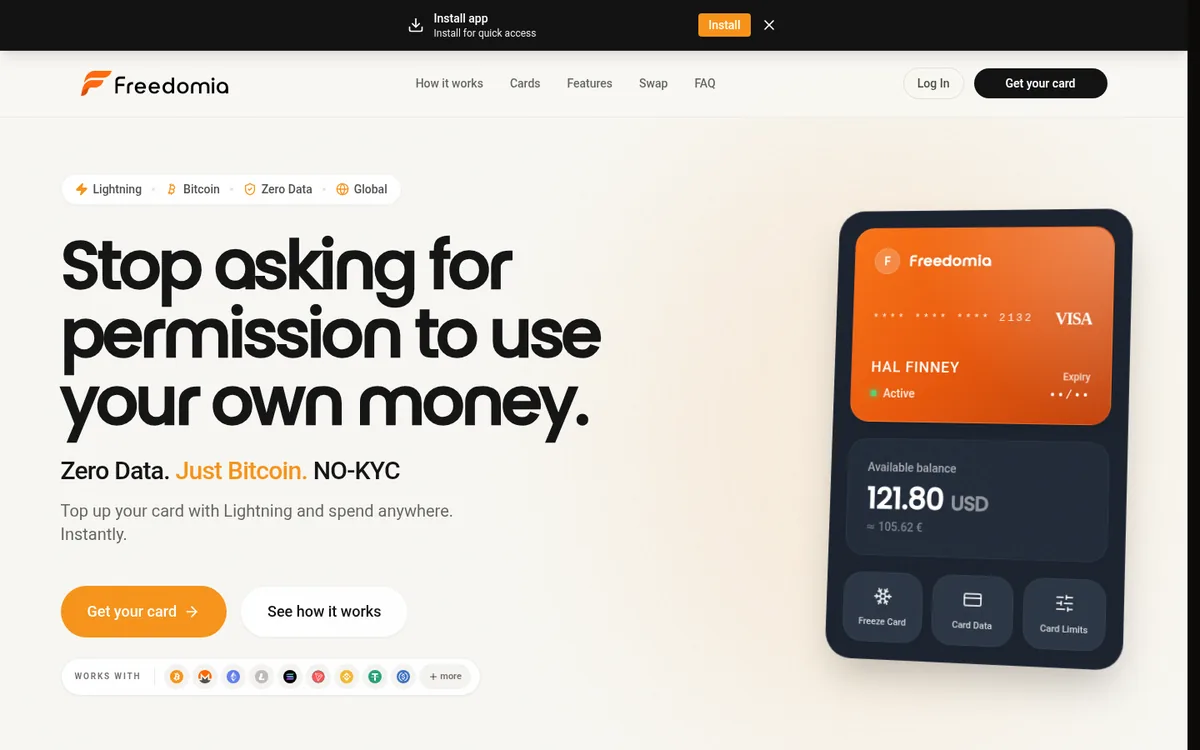
Freedomia homepage - live capture 2026-09-19
Freedomia is a virtual Visa prepaid card funded in crypto and positioned entirely around privacy: the homepage promises zero data, no verification and no approval, with a personal Lightning Address as the flagship top-up rail [1]. Bitcoin converts automatically to the USD card balance in the background, the card issues instantly with re-issue available anytime, and it is built for Google Wallet tap-to-pay on Android [1]. The operator self-declares as Freedomia Digital Group LLC, a Delaware entity at a registered-agent address [10], and deliberately does not disclose the card issuer, which it places in Hong Kong under BIN 493875 [1]. The balance is custodial - deposits convert into a USD balance held on the operator's side. About a year old, it targets privacy-first bitcoiners, digital nomads and people who cannot or will not hand over identity documents [1].
First-hand test (editorial)
The editorial desk has used this card hands-on as of November 2026. Google Pay worked everywhere we tried it, including contactless terminals in everyday shops, and cash withdrawals at ATM machines worked through Google Wallet NFC - the full tap-to-pay loop, not just online checkouts [6]. Signup required nothing but an email address; no identity documents, no proof of address, no selfie [1]. Support answered quickly on both channels we tested, email and Telegram, in the language we wrote in [17]. This is the first card in our set where every part of the no-KYC pitch survived contact with daily use.
Fees & Costs
The pricing is subscription-based: the Founder plan costs $5 per month, billed $60 annually, covering a $5,000 monthly and $60,000 annual limit [1]. The renewal price stays at $60 per year for life, with a possible future CPI adjustment reserved [8]. Announced successor plans, not yet available, are HODL at $9.99 per month and MOON at $17.99 per month with a $10,000 monthly and $120,000 annual limit [1]. The load fee is 1.3% on direct USDT/USDC deposits over Polygon [2] - the cheapest documented load fee in the no-KYC set we track, where comparable cards charge 3% to 3.5% [19]. Lightning routes add roughly 0.25% to 0.50% through swap providers [4]. The FX fee is 2.5%, waived entirely for USD spending, and the operator explicitly tells you to always pay in the local currency because merchant-side conversion is usually worse [3]. ATM withdrawals stack to roughly 6% total outside USD countries: around 2.5% processor FX plus a 3.5-4% processor and ATM network margin plus occasional ATM-owner fees [6]. In USD countries the FX part drops out [6].
KYC & Onboarding
No KYC is advertised and the FAQ states it plainly: no KYC is required to create and use the card within standard limits [2]. Signup is email-only, the cardholder name is freely chosen because there is no identity to verify, and no SIM card is needed - verification runs by email [2][7]. Card details arrive online after payment; issuance is instant and re-issue takes one click [1]. Multiple cards are supported, each with its own balance, limits and subscription [7]. The terms of service render their section contents only via JavaScript, which limits auditability of the governing text [1]. A no-KYC card has one documented KYC exception: opening a Visa chargeback requires ID or passport, documentary proof of the charge, and a $250 initiation fee [7].
Coins & Top-up
The cheapest and native route is USDT or USDC on Polygon, where the payment processor's own wallet lives [5]. Everything else routes through swap and bridge providers - SideShift, ChangeNow, Boltz, Satora - with additional conversion cost [2]. The current FAQ lists a wider asset set than at our last check: BTC on-chain and via Lightning, rBTC, L-BTC, ETH, SOL, BNB, LTC, plus USDT and USDC across Ethereum, Arbitrum, Solana, Tron, BSC, Avalanche, Optimism, Liquid and more [5]. Monero can be used for top-ups once the card is active [5]. The practical minimum on Polygon is around $15; other routes can require more [5]. Wrong-token and wrong-network deposits are recoverable only manually, with reference fees of around $50 on a $1,000 deposit and around $20 below $100, taking up to two weeks [5].
Rewards
There is no cashback or cardholder rewards program: the complete official FAQ and pricing contain no reward mentions [1][2]. What exists is the referral program described below, which pays the referrer, not the cardholder.
Referral & Affiliate Program
The program is public and tiered: from 10 referred paying users you earn $10 per signup plus 10% lifetime revenue share on their top-ups, from 20 users $15 and 15%, from 30 users $20 and 20% [9]. Below 10 referrals there is no commission, only free months [9]. Referred users get one or two free months depending on the referrer's tier [9]. Payouts are in USDT, managed from an in-house dashboard [9]. This explains most of the referral-link praise you will see on social media - we treat incentivized comments accordingly in the reliability section.
Support & Community
Support runs through email and through a private message to "Fer" on Telegram, handled in English, Spanish, French and German [17]. The official Telegram group counts 2,284 members with active sections in several languages [17]. The group's own description carries an anti-phishing warning worth repeating: no one from the team will ever DM you first, so any "support" message that arrives uninvited is an impostor [17]. Our hands-on support tickets in November 2026 were answered the same day on both channels [17].
Reliability & Red Flags
User evidence has grown since our last check and stayed positive. A long-term Bitcointalk user reports using the card since the launch thread and calls it possibly the best virtual card available today [12], and the bitcoin educators behind the Sovereign Sessions channel published a full walkthrough video in September 2026 [13][14]. Reddit long-term reports describe months of everyday use [15][16]. The launch-thread OP reports petrol stations as the long-known weak spot for card payments [11]. Against that: the card issuer is deliberately undisclosed [1], public BIN lookups on 493875 returned three different names in our October check, none a deposit-protected bank [1], and 3DS verification codes run through the operator's own shared phone numbers forwarded by email - the guardrail is the operator's SMS pipeline [1]. The balance is custodial with no standard way back on-chain, and a lapsed subscription forfeits the remaining balance after 30 days [7]. Dispute protection is effectively priced out by the $250 KYC-gated chargeback process [7]. Blocked merchant categories include gambling, money transfers and unattended pay-at-pump fuel, and some merchants reject Hong Kong-issued cards outright [7]. Automated watchdogs disagree: ScamAdviser flags a slightly low trust score over hidden WHOIS ownership [20], while the KYCnot.me community listing rates privacy high and trust middling - and marks itself as unchecked [18]. We identified and excluded an astroturf referral-comment pattern from mid-2026 [11], and a promotional comparison page markets Freedomia as a "PayWithMoon alternative" with self-submitted rating markup [21]. No loss incidents are documented to us as of the facts date. Our fact set remains provider-documented and not independently verified, with the exception of our own hands-on use.
Verdict
If a no-KYC card is what you need, this is the most complete implementation of that pitch we track: instant virtual Visa, Lightning top-ups, Google Pay and ATM withdrawals that actually work, fast multilingual support, honest fees and a year of positive user reports [1][6][7][12]. The counterparty risk is structural, not cosmetic: custodial balance, anonymous-feeling operator, undisclosed issuer, no way back on-chain and a dispute process that demands KYC plus $250 [1][7]. Keep balances minimal, top up what you plan to spend, and never store savings on it.
What works
True no-KYC onboarding with Lightning Address top-ups, alias names accepted and no SIM required
Instant virtual Visa with Google Wallet support - tap to pay and ATM withdrawals via NFC work in practice
Cheapest documented load fee in the no-KYC set (1.3% on Polygon) and a published, complete fee stack
Responsive multilingual support by email and Telegram (editorial hands-on, Nov 2026)
~12 months in operation with positive user reports (Bitcointalk, Reddit, Sovereign Sessions video) and no documented incidents
What to watch
Custodial balance with an operator whose card issuer is deliberately undisclosed
No cashback; rewards limited to referral free months
2.5% FX fee outside USD
Balance cannot be withdrawn back on-chain; leftover balance is forfeited 30 days after subscription expiry
Visa chargeback requires KYC documents plus a $250 initiation fee - dispute protection is effectively priced out
Blocked merchant categories include gambling (MCC 7995), money transfers (MCC 4829) and unattended pay-at-pump fuel (MCC 5542); some merchants reject Hong Kong-issued cards
3DS and Google Wallet verification codes go to the operator's shared phone numbers (forwarded by email, not the user's device) - the 3DS guardrail is the operator's own SMS pipeline
Young operator - about a year on the market (domain since 2025-10), short track record for a custodial balance
TOS section contents render only via JavaScript (headings server-side, FAQ in plain text) - the governing terms are hard to audit
Fee reality check
Issuance
Digital card issuance included in subscription; instant issuance, re-issue anytime
Monthly
$5
Top-up fee
1.3%
FX fee
2.5%
ATM fee
3.5% ATM withdrawals DO work (official FAQ: 'Yes, if the ATM supports the method you are using' - Google Wallet NFC at contactless/NFC ATMs; compatibility depends on ATM and country). Official fee breakdown: card processor FX fee ~2.5% (waived for USD/local-USD) + payment processor / ATM network margin ~3.5-4% + occasional fixed fee charged by the ATM owner; total cost 'can therefore be around 6% in some cases'. fee_atm_pct records the 3.5% processor/ATM-network margin; the 2.5% FX component is tracked in fee_fx_pct.
Fine print
Founder plan $5/month billed $60 annually, price locked forever (launch offer); renewal price stays $60/yr for the Founder plan 'except for a possible future adjustment for inflation (CPI), indexation or similar'. Announced upcoming plans: HODL $9.99/mo (billed $119.88/yr), MOON $17.99/mo (billed $215.88/yr, $10k/mo and $120k annual limits). Top-up fee 1.3% for direct USDT/USDC deposits on Polygon; other tokens/networks add swap/bridge costs (providers SideShift, ChangeNow, Boltz, Satora); Lightning beta routes add ~0.25-0.50%. FX fee 2.5% standard, 0% for USD spend; always pay in local currency - the operator explicitly warns the merchant's own conversion is usually worse. ATM via Google Wallet NFC: ~2.5% FX + ~3.5-4% processor/ATM-network margin + possible ATM-owner fixed fee (~6% total typical; USD countries ~2.5% lower). 'No hidden fees from Freedomia' per FAQ. Support: priority on Founder/MOON, standard on HODL. Renewal runs on the card's own balance by default; card frozen at expiry, permanently deleted 30 days after expiry (remaining balance is lost).
Three steps, based on the operator-documented facts in this review (fact status: checked 2026-11-07):
Sign up. the operator documents no identity documents at signup - note that usage triggers (loads, ATM, disputes) can still flip anonymous accounts into verification later.
Top up. Native top-up coins: BTC, BTC-LN, XMR, ETH, LTC, SOL, TRX, BNB, USDT-Polygon, USDC-Polygon. Minimum load: Practical minimum ~$15 for direct Polygon top-ups (official FAQ); other routes may require higher minimums depending on the swap provider. Lightning top-ups are supported. Load fees are in the fee table above.
Spend or withdraw. a virtual card for online payments. ATM withdrawals are documented - check the ATM fee rows above before relying on cash.
Check your country. Documented region: worldwide. Run the region checker for exclusions named by the operator.
Based on our checks as of 2026-11-07: Freedomia scores 7.2/10 in our weighted review. It operates without KYC - which means outside regulated card frameworks; treat the balance as at-risk counterparty money. We logged no red flags. User reports and the operator background are documented with dated sources in the meta-review below.
The meta-review: what the internet says about Freedomia
We do not expect you to trust us. This review is a meta-review: below you see what other review sites claim, what users report on Reddit and forums, and who actually operates Freedomia - including the issuing structure behind the card. Every claim links to its source so you can verify it yourself. Our verdict forms from these sources plus our own fact checks - not the other way around.
What other reviewers say (3)
Heads-up: most crypto card "reviews" are affiliate content. We mark our reliability judgement on every source and include critical voices deliberately.
Cardpilled (last verified 2026-08-27): $60/yr ($5/mo Founder tier), Global, no identity verification. Only source naming an operator: the legal page reportedly cites 'Freedomia Digital Group LLC (Delaware)' - no issuing bank, BIN sponsor or licence published. Quotes KYCnot.me: privacy 96/100, trust 52/100, service holds the private keys, no track record, still in beta. We could not independently verify the LLC claim (freedomia.io terms page is JS-rendered; Wayback 2026-08-23 snapshot also shell-only).
'you have non-KYC options like Freedomia, I personally have been using it for a while and it is my main spending card now, I top it up with a Lightning wallet' - substantive long-term praise.
'Yo uso freedomia desde hace unos meses y todo muy bien, es internacional y pago la mayoria de mi entretenimiento con esta. Lo que no he podido en Mex es retirar efectivo desde cajero, es tarjeta digital' - months of trouble-free use; cash withdrawal at Mexican ATMs not possible.
Service-Discussion thread (767 reads, merited) by Legendary Don Pedro Dinero: email-only signup, $5,000/month without KYC, virtual Visa, Google Pay NFC incl. ATM withdrawals; Spanish forums report it works well except at petrol stations. Users confirm the 1.3% top-up fee and 2.5% exchange fee ('card is US based so everything is charged in dollars'). yhiaali3 (Legendary) bought it from a sanctioned country and criticizes the $60 annual-only plan. Veteran caution: 'never hold more money than you are willing to lose'; 'what guarantees are there that this new company will last a year?'
2 284 members, 206 online. To join, you must complete the CAPTCHA sent by the Bot via DM when you request to join. No one from the team will ever DM you first
'I get paid in BTC... services I use: Freedomia - KYC free card.' Listed among the poster's actual toolset.
Who is behind Freedomia?
Card programs stand and fall with their operator and BIN sponsor. This is what we could verify - with sources. Confidence: medium (checked 2026-10-15).
Operator
Freedomia
Legal entity / issuer
Freedomia Digital Group LLC (self-declared, Legal Notice 2026-10-15); registered-agent address 131 Continental Drive Suite 305, Newark, DE 19713; card issuer/BIN sponsor still unnamed
Registered in
US (Delaware)
Legal notice (freedomia.io/legal, updated 2026-10-15) names Freedomia Digital Group LLC, Delaware; stated business purpose also lists training courses and consulting. No licence published. FAQ: 'some merchants may reject cards issued from Hong Kong' - issuer remains unnamed. WHOIS privacy-protected. Operator statement (email to the editor, 2026-10-15): Visa issued in Hong Kong, BIN 493875, issuer name deliberately withheld. BIN lookups 2026-10-15 conflict: binlist=Reap Technologies Limited, handyapi=Unicard Solution Ltd, antipublic=Yinsheng E-Pay Services (HK) Ltd.
Every external source used on this page, with the date we fetched it. Methodology: how we verify. Sources disappear or change - if a link is dead, tell us via contact. Quoted text is the verbatim excerpt this review cites.
“The card balance is held in USD, and if you pay in another currency, the payment processor applies a 2.5% FX fee. ... You should always choose the local currency.”
“For direct top-ups on Polygon, the practical minimum is usually around 15 USD. ... Supported assets may include BTC, ETH, SOL, BNB, LTC, rBTC, L-BTC, USDT, USDC, and more”
“Can I withdraw cash from an ATM? Yes, if the ATM supports the method you are using. ... Daily: 3,000 USD, with up to 3 withdrawals per day ... Yes. Freedomia works with Google Wallet on compatible Android devices.”
“starting a chargeback requires KYC and user documentation (ID or passport), documentary proof of the charge (receipts, invoices or tickets), and a 250 USD fee to initiate the process. ... 30 days after expiry: the card and its associated account are permanently deleted.”
“If you have the Founder Plan, the renewal price stays at 60 USD per year for life, except for a possible future adjustment for inflation (CPI), indexation or similar.”
“2 284 members, 206 online. To join, you must complete the CAPTCHA sent by the Bot via DM when you request to join. No one from the team will ever DM you first”
The strongest physical no-KYC card pitch: a real Mastercard with ATM access, 0% FX and 0% ATM fees, XMR deposits and privacy-preserving support channels. The trade-offs are a $350 entry price, 3.5-4% deposit fees and an unlicensed custodial balance - treat it as a privacy tool, not a bank account.
A Monero-capable virtual Mastercard with Apple/Google Pay support and $10-$10,000 loads - a rare direct-XMR card. Until fees, limits and the operator behind it are verifiable, treat it as an unverified lead: fund only what you can afford to lose.
A documented, fully-priced stablecoin Visa program with named regulatory registrations - but unresolved mega-litigation changes the risk picture: Binance sued RedotPay and its founders for ~$472.8M in August 2026 over alleged user-asset diversion. Custodial balances, freeze powers, no named issuer. Treat as usable-but-contested; keep balances minimal and watch the litigation.



No comments yet - be the first. No account needed; the anti-spam proof runs in your browser.