Cards you can order and load without identity verification - with the honest risk notes the marketing leaves out.
Short answer:Freedomia is our top-rated no-KYC crypto card as of 2026-11-07 (7.2/10), No KYC, 1.3% load fee.
cards on this page: 3 · issuing today (excl. watch list): 3 · independently verified facts: 0% · no KYC at first use: 100%
quick picks
the cheapest documented no-KYC load fee→Freedomia - 1.3% load vs 3.5-6.5% at the other two, plus Lightning top-up - the fee spread in this niche is wide enough to decide alone
no-KYC with zero fixed costs→Goblin Card - $0 monthly and 0% listed FX; the cost concentrates in the 3.5% load fee, which is the honest place for it
The most complete no-KYC crypto card we track: instant virtual Visa, Lightning Address top-ups, Tor support, working ATM withdrawals via Google Wallet NFC, responsive multilingual support and a year of positive user reports with no documented incidents. The fee stack is honest and the 1.3% load is the cheapest in the no-KYC niche. Counterparty risk stays material - the issuer is undisclosed, the operator is a self-declared Delaware LLC at a registered-agent address, balances are custodial with no way back on-chain, and even a chargeback demands KYC and $250. Treat it as a spending pipe: top up, spend, replace.
best no-KYC pickNo KYCLightningXMR direct
1.3% load · 2.5% FX · no cashback
$5,000 (Founder/HODL); $10,000 (MOON, announced)★★★★☆4 (1)Crypto-native 40 h ago
The strongest physical no-KYC card pitch: a real Mastercard with ATM access, 0% FX and 0% ATM fees, XMR deposits and privacy-preserving support channels. The trade-offs are a $350 entry price, 3.5-4% deposit fees and an unlicensed custodial balance - treat it as a privacy tool, not a bank account.
A Monero-capable virtual Mastercard with Apple/Google Pay support and $10-$10,000 loads - a rare direct-XMR card. Until fees, limits and the operator behind it are verifiable, treat it as an unverified lead: fund only what you can afford to lose.
The market is three programs deep - that is the finding
The honest state of no-KYC crypto cards in 2026: a short list. Freedomia, Goblin Card and 2Fiat - all Monero-loadable (via swaps), all onboarding without identity documents, none carrying independent verification (0% of fee data verified). 2Fiat went unreachable for about two weeks in October 2026 and came back without an explanation - a live reminder of how fast this niche's operators disappear. Everything else in this market has moved to email-at-minimum or full KYC, usually because the issuer BIN demands it [8]. If a page advertises a "no KYC crypto card" with cheap fees and wallet provisioning, it is either new (unproven) or the trigger is buried further down the funnel.
The deferred-KYC flow: signup without documents, triggers on usage, freeze, resolution.
Where the paper trail actually starts
The trigger ladder for this niche, as documented in the terms: cumulative load volume (the most common threshold - a pattern of many small loads is more visible than one large load), single large top-ups above documented caps, ATM withdrawals (the classic trigger), and disputes - a chargeback on an anonymous prepaid account ends the anonymity instantly, because you cannot file a dispute without identifying yourself. The trigger lives in the terms, not the signup flow; the risks guide walks the full ladder with the documented failure patterns.
Live values from our database - details and caveats in each review. "-" = not published by the operator.
Warning: The freeze, not the fee, is the real cost of this niche. A balance frozen pending documents is illiquid for an undocumented duration, and in the terminal case - a sponsor exiting, as Kulipa did in July 2026 taking ~120,000 cards with it [7] - the recovery is a payout queue, not a balance. Rule of thumb: this product class carries spending money, never stored money.
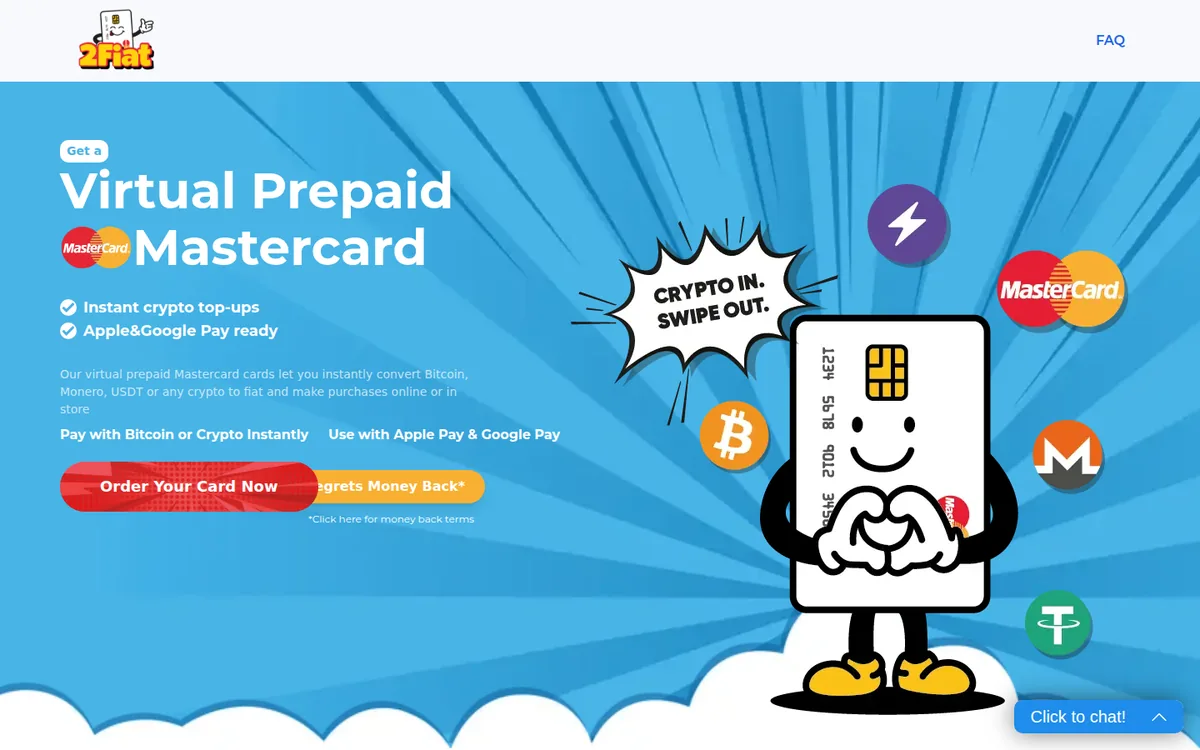
2Fiat, live capture - the niche's steepest load fee (6.5%), a community-reported number the operator has never confirmed in a numeric fee table; the site survived an unexplained two-week outage in October 2026.
Fee tables: what skipping the paperwork costs
The documented stacks across this set differ by a factor of five on the load line: Freedomia at 1.3% load plus 2.5% FX plus $5/month [1], Goblin at 3.5% load with 0% listed FX and $0 monthly [2], and 2Fiat at a community-reported 6.5% load plus 2.5% FX [4][5] - numbers the operator has never confirmed in its own served pages (its FAQ API now names a 1-3% network FX spread instead), and whose site spent mid-to-late October 2026 unreachable before returning without an explanation. Every stack is more expensive than the cheapest verified alternatives - on a $200/month spend profile the premium is roughly $3-15/month versus the fully-verified set. Whether that premium buys something you want is the personal decision this page exists for; the community threads [5] are a better read on service quality than any landing page.
The ATM line deserves its own warning: Freedomia's wallet-NFC withdrawals document a total cost around 6% at some machines once processor margin and ATM-owner fees stack [1], Goblin's plastic is 0% issuer fee with operator surcharges possible [2], and 2Fiat supports no withdrawals [4]. In this niche, cash is the most expensive feature and the strongest KYC trigger - both facts argue for treating it as emergency-only.
The 2026 context: why the market shrank
The EEA's MiCA transition ended in July 2026 with enforcement, BIN sponsors consolidated, and the issuer layer had its worst month in years - Kulipa's wind-down erased programs including Solflare's card overnight [7]. Anonymous-adjacent products were the first cut. The three survivors share a profile: fee-funded (no cheap subsidized rates), issuer-transparent about their own restricted countries [3], and small enough to be under the compliance radar that killed larger programs. None of that is a guarantee - it is the current shape of the market, and 3 is the number to watch: when it changes, this page changes.
The fee premium needs this context to read correctly: the 1.3-6.5% load line is not gouging on its face - it is the price of a compliance posture that the rest of the market abandoned, paid by the users who still want it. That price is also the market's honesty mechanism: when a no-KYC program advertises cheap fees, the subsidy is coming from somewhere - usually the balance risk you carry. The survivors charge what the deferred-KYC model costs, and the ~2.4% median load fee across this page is the highest in our whole comparison set.
The privacy frame, honestly
What "no KYC" delivers: no identity document at the issuer, delivery flexibility for plastic, and a funding chain that can start from privacy coins (the Monero hub covers the swap layer). What it does not deliver: transaction privacy (the network sees everything), exemption from tax law (disposals are taxable regardless of paperwork), or immunity from on-chain screening (flagged funding chains freeze before the card matters). Users whose threat model needs actual transaction privacy should look at the spending architecture, not the onboarding - the self-custody hub is the structural answer.
The layered view is the useful one: onboarding privacy (no documents - what this niche sells), funding privacy (Monero in - what the swap layer buys), and transaction privacy (the network layer - which no card delivers). The three products here sell the first layer only, and the fee table prices exactly that. Users who conflate the layers end up disappointed in different ways - the onboarding-privacy buyer is fine here, the transaction-privacy buyer is looking at the wrong product page entirely.
Using this market, practically
The playbook that the failures have taught: load the minimum on the first use and verify the receipt; keep balances under what a week of freeze would hurt; spend fast rather than store; screenshot every transaction and terms page (the terms change without notice in this niche); and re-verify the trigger clauses before any load that is larger than your usual pattern. Add the community check before committing: the PrivacyGuides thread [5] and successor threads are where freeze stories surface first, weeks before terms pages change. If the premium stops being worth it, the verified Europe cards are the fallback - most EEA fintechs verify quickly and cost far less. The ranking above is the complete set in score order; its brevity is the information, and 3 of the three programs take Monero natively - the spend-monero guide covers the funding chain that makes this niche what it is.
Three on our tracked set (Freedomia, Goblin Card, 2Fiat) onboard with no identity documents, all Monero-loadable via swaps. None is independently verified by this site, and all run high load fees (1.3-6.5% community-reported at 2Fiat). 2Fiat survived an unexplained two-week outage in October 2026 - the niche's operational risk made visible. "No KYC" in 2026 means "KYC deferred behind usage triggers" - not "no identity records anywhere" [6].
What triggers KYC on a no-KYC card?
The documented triggers across this niche are cumulative load volume, single large top-ups, ATM withdrawals, chargebacks and fraud flags. The trigger lives in the terms, not in the signup flow - reading it before your first big load is the whole game. ATM cash extraction is the classic trigger: it is where every compliance officer looks first.
What happens if a trigger fires?
The balance freezes pending identity verification - spend stops, top-ups stop, and resolution time is undocumented in this niche (days to indefinite). This is the core risk the frozen balances guide walks through: your money sits on the issuer's rails, not yours. The July 2026 Kulipa collapse showed the terminal case - ~120,000 anonymous-friendly cards became a payout process overnight [7].
Why are the load fees so high here?
Three compounding reasons: the issuer charges for acquiring anonymous-looking customers, the payment rails (XMR/BTC in, often via swaps) cost more, and operators price in freeze and chargeback losses. The market charges a 1.3-6.5% premium for the paperwork you skip - and the spread between the three programs (1.3% vs 6.5% for comparable products) tells you that premium is a pricing choice, not a cost floor.
Is a no-KYC card good for privacy?
It reduces the paper trail at the card issuer, not at the transaction layer - every card purchase still produces merchant, BIN and network records, and the BIN identifies the program [see the virtual hub]. For most threat models, "privacy" here means "no ID photo on file", which is a different thing from transaction privacy. The Monero hub covers the funding side where privacy is real.
Are these cards legal to use?
Using a prepaid card without submitting KYC is not itself illegal in most jurisdictions; the compliance duty sits with the issuer. Your duties are tax and sanctions law, which apply regardless of paperwork - and on-chain freezes for flagged funding chains happen before any card KYC would have mattered. We do not give legal advice; check your local rules.
What does the missing verification actually mean?
0% of this page's fee data is independently verified - which is to say none of it is. Fees and terms are operator-reported: we read the published pages, but there is no second source confirming Freedomia's 1.3% load or 2Fiat's 6.5%. The practical mitigation is the first-load discipline: minimum amount, one transaction, receipt checked - before any balance exists to freeze.
Can I withdraw cash from a no-KYC card?
One of three paths works: Goblin's plastic at 0% issuer fee (third-party operator surcharges still apply); Freedomia's wallet-NFC route at documented total costs "around 6% in some cases" (processor margin plus ATM-owner fees); and 2Fiat not at all - the FAQ states withdrawals are not supported [4]. Cash is the most KYC-triggering activity and the most expensive - price it before planning around it.
Why did this market shrink to three programs?
Compliance consolidation. The EEA's MiCA regime ended the transition period in July 2026 [8], BIN sponsors tightened onboarding, and issuer failures (Kulipa, July 2026 [7]) took out programs that served anonymous users. The three survivors are the ones whose sponsors accepted the deferred-KYC model - and their high fees are the price of that acceptance, paid by users.
What is the biggest operational mistake in this niche?
Storing money. The product class carries spending money - load, spend, repeat. A balance held for weeks on an unverified program is exposed to freeze, terms change and sponsor failure with no recourse and no second source. The no-KYC risks guide documents the failure patterns; the short version is load small, spend fast, screenshot everything.
Do no-KYC cards report anything to anyone?
The card network sees every transaction (merchant, amount, BIN); the issuer holds whatever records its onboarding created (email, delivery address for plastic); and sanctions screening applies at the chain level regardless. "Anonymous" describes the absence of an identity file at the issuer - not the absence of records. Privacy-sensitive users should read the Monero hub for where privacy actually lives in a spending stack.