Trustpilot reviews (archived November 2025)
They closed my account because I asked for a refund and they won't give me my money back.

A niche virtual-card tool for online media buying with crypto funding - now with a named operator (ADV Summit Advisors Limited, TCI) and documented fees. Usable for its purpose, but the 3% cashback is a Private-subscription ad-spend benefit paid as subscription credit, and the regulated issuing side remains unnamed. Poor as a general spending card; keep balances minimal.
site reachable · checked 10 h ago · daily check
by the cryptodebitcards editorial desk · curated review · prose updated 2026-10-01 · facts as of 2026-10-01 · how we verify
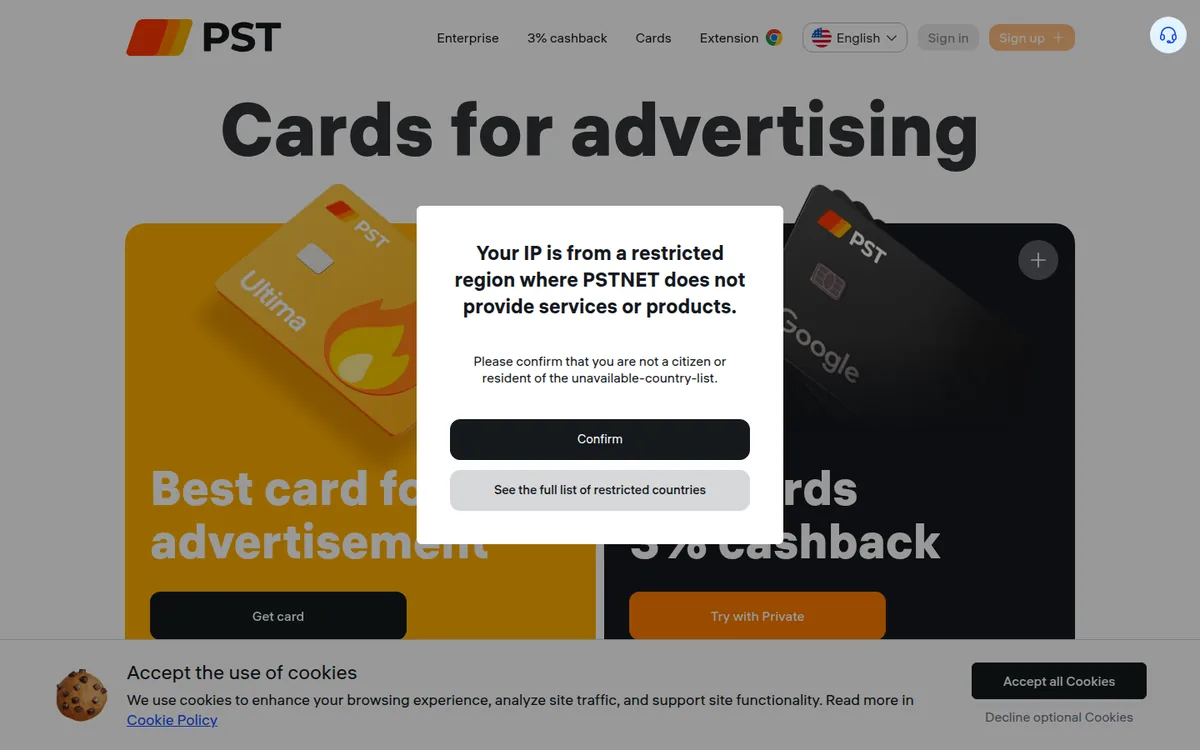
PST.NET sells virtual Visa and Mastercard prepaid cards aimed at online media buyers, funded with USDT or BTC [1]. The operator question that used to be this card's biggest red flag is now answered in the official legal documents: the platform is operated by ADV Summit Advisors Limited, registered in the Turks and Caicos Islands, while the regulated issuing, safeguarding and settlement functions run through unnamed Financial Partners [2]. The product is a tool for a niche - media buyers funding ad platforms - not a general spending card [4]. Cards come in several types with concrete published prices, and the whole flow is custodial: balances sit on the platform, not in your wallet [1][2].
The documented stack, from the official FAQ and card pages [1][3]: adding funds to the account is free, while loading a card directly can cost a card-type-dependent fee of at least 1 dollar. The monthly maintenance fee equals the issuance fee and is charged every 30 days after the first included month - Advertising, Google and TikTok cards at 10 dollars, the Ultima card at 16 dollars, Platinum spend-dependent [3]. Transactions with merchants outside the United States carry a cross-border fee of 1 to 3 percent, with a 0.50-dollar minimum on transactions under 5 dollars and 1 dollar above [1]. Withdrawals run in USDT on the TRC-20 network only, from a 10-dollar minimum, free of charge, with manual review of up to 14 days [1]. Two punitive items are codified in the legal documents: a prohibited-use charge of 30 percent of the transaction value (minimum 5 dollars) [2], and a 30-day window to rescue any balance from a blocked or closed card [1].
Full eKYC is required: a government-issued ID photo plus a selfie liveness check, handled by Sumsub and usually completed in under 24 hours [2]. The AML policy, updated in September 2026, documents the same provider [2]. Onboarding itself runs in the PST.NET dashboard or Telegram bot [1]. Citizens and residents of a documented restriction list - including the US, Canada, Russia, Belarus, Ukraine, China, Hong Kong and Serbia - cannot onboard [2].
The account is funded with USDT or Bitcoin, instantly per the official pages [1]. Cards are issued in US dollars by partner banks in the United States [1]. Card top-ups draw from the account balance [1]. Withdrawals only run in USDT on the TRC-20 network, free, subject to the 14-day review window [1]. There is no direct on-chain spending, no Lightning, and no non-custodial step anywhere in the flow [1][2].
The cashback is narrow and subscription-bound: 3% on Google and TikTok advertising spend, available on the Private subscription plan, capped per plan with a minimum of 0.10 dollars per transaction, excluded on Ultima cards [4]. Crucially, it is not paid in crypto: cashback is credited on subscription-renewal day and automatically applied toward the next renewal if sufficient [1]. That is a subscription discount mechanism, not spendable rewards. No cashback exists for general purchases on any documented card type [1].
The transparency story improved measurably: the entity is now named in the Restrictions document, the AML policy names Sumsub [2], and the official BIN checker exemplifies issuing banks as Citi, Wells Fargo and TD - though none is contractually named as the issuer of record [5]. The complaint record is mixed: a November 2025 archived Trustpilot review documents an account closed under a Compliance restriction after a refund request [6], and a 2023 Bitcointalk case describes a 27,500-dollar deposit withheld pending review, with the operator responding in-thread about 14-day refund windows [7]. The r/Scams allegations in our source list dissolve on inspection - one post body was deleted and the other describes an impersonation scam that never names PST [1]. The 30-percent breach charge and the unnamed issuing side remain the structural caveats [2]. Our fact set is not fully verified (reported) as of the facts date.
A workable niche tool for media buyers who need stablecoin-funded virtual cards with ad-spend cashback [1][2]. It is a poor general spending card: cross-border fees on non-US merchants, subscription-topped pricing, no physical cards, and custodial balances behind a 14-day withdrawal review [1][3]. Keep balances minimal, and treat the 3% cashback as what it is - credit toward your own subscription renewal [4].
| Top-up fee | 0% |
|---|---|
| Fine print | Account top-up fee-free (official FAQ, checked 2026-10-01). Card-load fee card-type-dependent, never less than $1. Monthly maintenance = the issuance fee, charged every 30 days after the first included month: Advertising/Google/TikTok cards $10, Ultima $16, Platinum spend-dependent (official card pages). Cross-border transactions 1-3% (min $0.50 below $5, $1.00 above). Withdrawals: USDT-TRC20 only, min $10, free, manual review up to 14 days. Prohibited-use charge 30% of transaction value, min $5 (Restrictions 6.2). Card balances must be moved back within 30 days of card closure. A Chrome-store listing claims a 2% top-up fee for Private customers - third-party, not the FAQ. |
Run the numbers: true-cost calculator for this card →
Three steps, based on the operator-documented facts in this review (fact status: checked 2026-10-01):
Affiliate page live (200); the page renders client-side and the terms were not extractable. Terms not public from our research IP.
Compared in detail on Best referral programs. Checked 2026-09-30.
Ready to try PST.NET? Start small: minimum load, one test payment, one withdrawal.
Based on our checks as of 2026-10-01: PST.NET scores 4.4/10 in our weighted review. We logged 5 red flags (listed above). User reports and the operator background are documented with dated sources in the meta-review below.

A documented, fully-priced stablecoin Visa program with named regulatory registrations - but unresolved mega-litigation changes the risk picture: Binance sued RedotPay and its founders for ~$472.8M in August 2026 over alleged user-asset diversion. Custodial balances, freeze powers, no named issuer. Treat as usable-but-contested; keep balances minimal and watch the litigation.

A non-custodial stablecoin wallet with a Wirex-issued prepaid card: documented 1-8% cashback tiers in stablecoins, free virtual card, Apple Pay/Google Pay and up to 5% APY. The rewards are real but tiered behind $COCA balances, the official pages contradict each other on cashback rate and card network, and the independent FX spread measurement undercuts the 0% FX marketing. Verify the current card terms in-app before loading.

A real, shipping product from a well-funded Solana ecosystem team (Solayer Labs), now branded Solayer Pay after launching as the Emerald Card in April 2025. Virtual + physical Visa-compatible cards, Apple/Google Pay, ATM access, USDC-funded. Weaknesses: fee stack ($20/yr + 1% top-up + $0.15/txn + FX), no standing cashback (points with future promised utility), heavy restrictions (17 US states, most of Western Europe, CA/AU/NZ/IN/KR excluded), issuer not published, and 'non-custodial' marketing that contradicts its own hot/cold wallet security description. Fees/limits transparency is actually good (dedicated docs) — more than most competitors publish.
No comments yet - be the first. No account needed; the anti-spam proof runs in your browser.